
What Are the Best Apps for a Structured Chinese Learning Path?
Stop collecting apps. A structured Chinese learning path needs one app that owns the sequence and a few tools that know their place. Here is how I set mine up around SureChinese.
At one point I had five Chinese apps on my phone. A flashcard deck, a dictionary, a graded reader, a tones drill, and a chat bot. All good. I was studying every day and going nowhere, because every morning I had to decide which one to open, and every app thought it was the main event.
Here is what fixed it, and it is the answer to the question in the title: one app owns the path. Everything else is a satellite. The spine app decides what you learn next, brings old material back, and makes you produce language. The satellites solve one named problem each. If a tool cannot tell me what job it does, it comes off the phone.
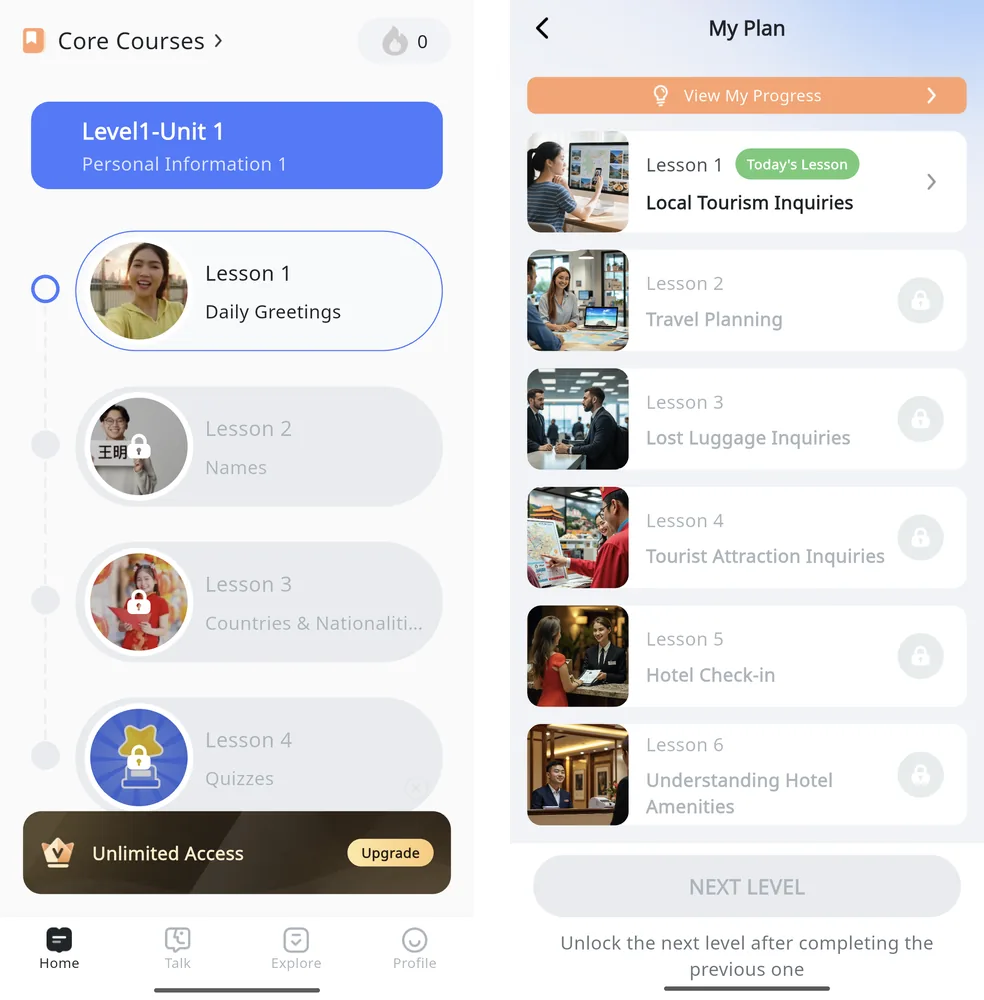
For the spine, I use SureChinese. Its courses are structured around HSK 1–4, every lesson works listening, speaking, reading, and writing together, and the Talk tab hands you one real conversation a day. I ran a free account through it from the first screen, and the rest of this piece is what a structured path looks like when you can actually see it.
Why Five Good Apps Add Up to Zero
Each app on its own was fine. Together they had no order. One introduced new words, another reminded me to review words I had never been taught, a third wanted to chat about topics I could not yet read. Nobody was in charge, so I was in charge, and I am a terrible curriculum designer at seven in the morning.
A structured system fixes that by giving one app the sequence and making the others earn their keep. It also makes progress visible. When a single app owns the path, you can see whether your listening is keeping up with your reading, because both are happening in the same lesson.
Five Things a Structured Path Has to Show You
1. Where you start
The first screen should tell a total beginner where to begin, and let someone with a bit of Chinese find their level without a placement exam they cannot yet pass.
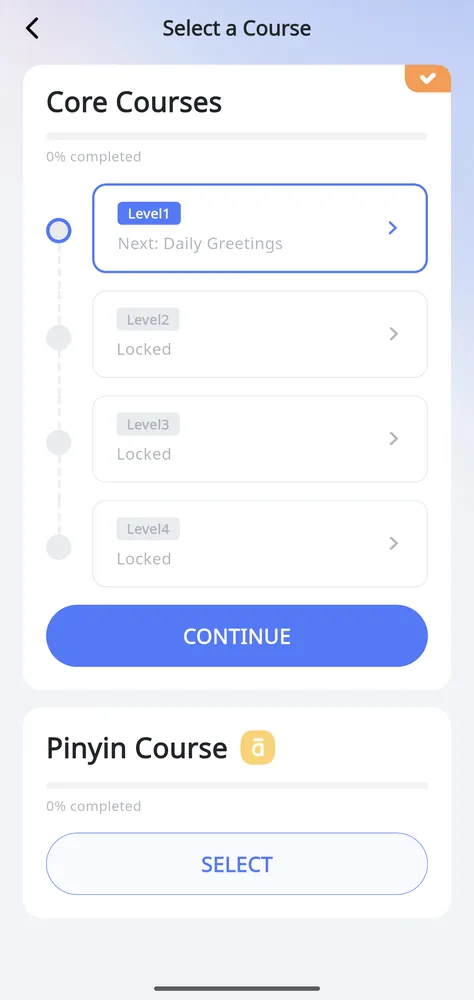
SureChinese puts the whole range on one page. The course-selection screen lists Level 1 through Level 4 in order, names the next lesson under Level 1, and marks the later levels as locked. Beside it sits a separate Pinyin Course for anyone who wants the sound system nailed down first. Pick one, switch later. Nothing to configure.
2. That later work builds on earlier work
This is the test most apps fail quietly. Words get introduced and never come back. Grammar sits on a card nobody reads.
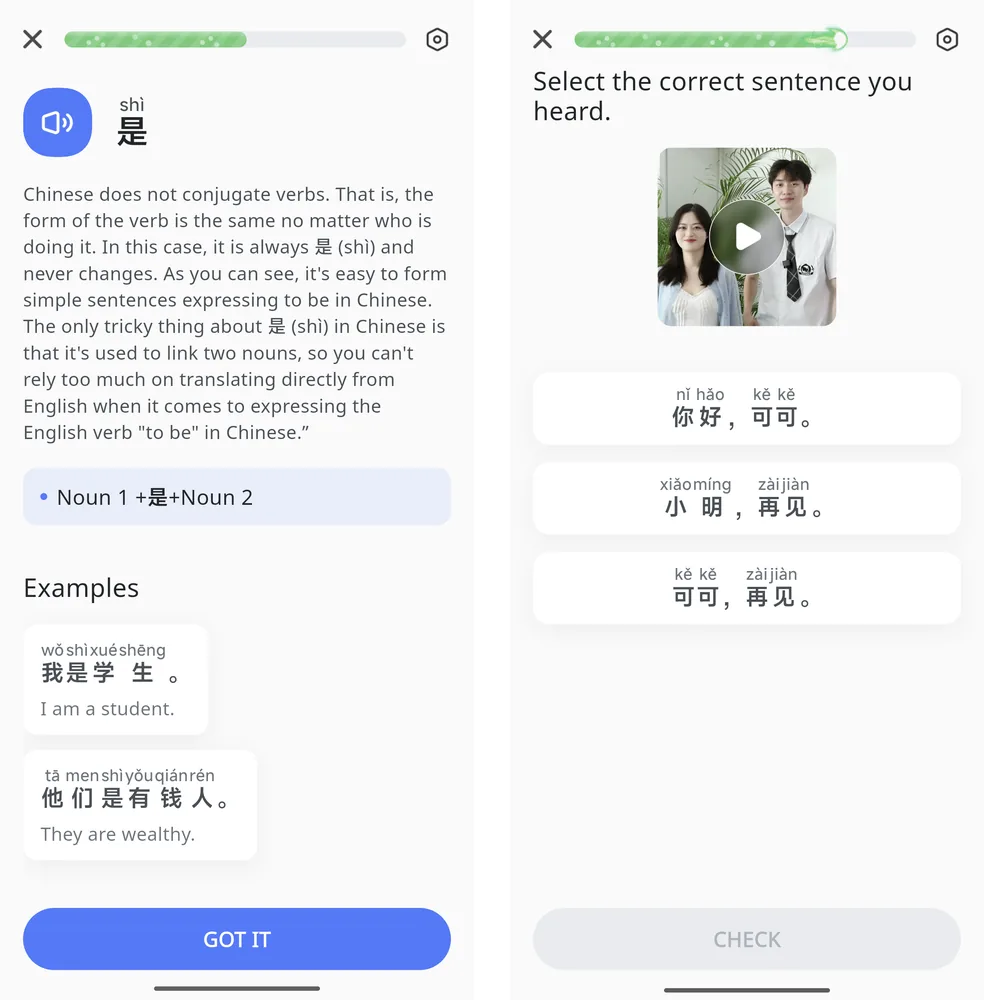
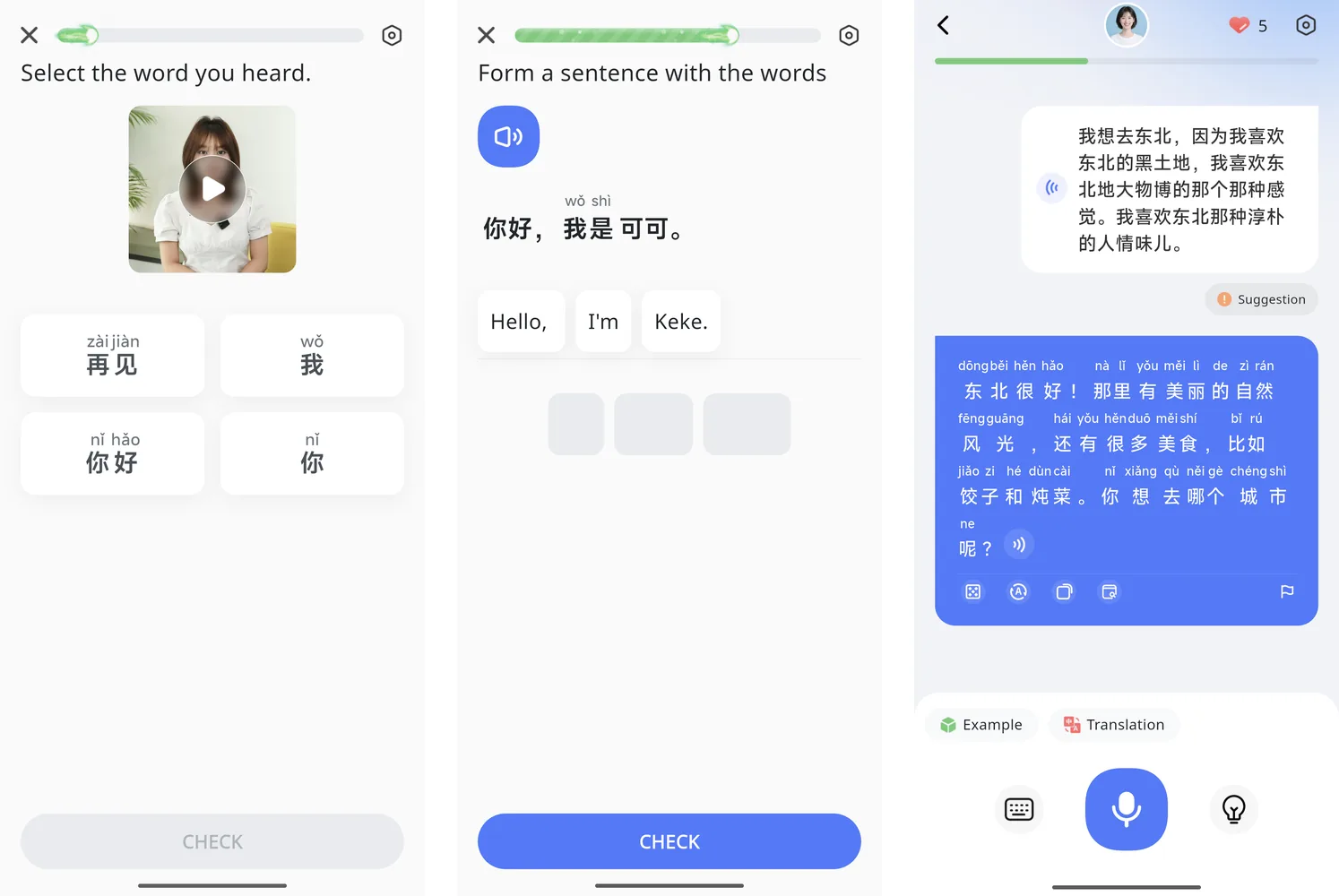
I watched SureChinese do the opposite inside a single lesson. Early in Lesson 1, a teacher on video says a greeting and you pick what you heard from three options: 你好,王小明。, 你好,我是王小明。, and 你好,我是可可。 The only difference is whether 我是 ("I am") is in there and which name follows. A few screens later a grammar card spells out the pattern: Noun 1 + 是 + Noun 2. Then 是 comes back as a character you have to write. You hear the pattern, then you read the rule, then you write the character. Nothing is taught once and dropped.
3. A way back to what you missed
Meeting a word once is not learning it. A structured path has to bring your misses back, and it has to make that easy, or you will not do it.
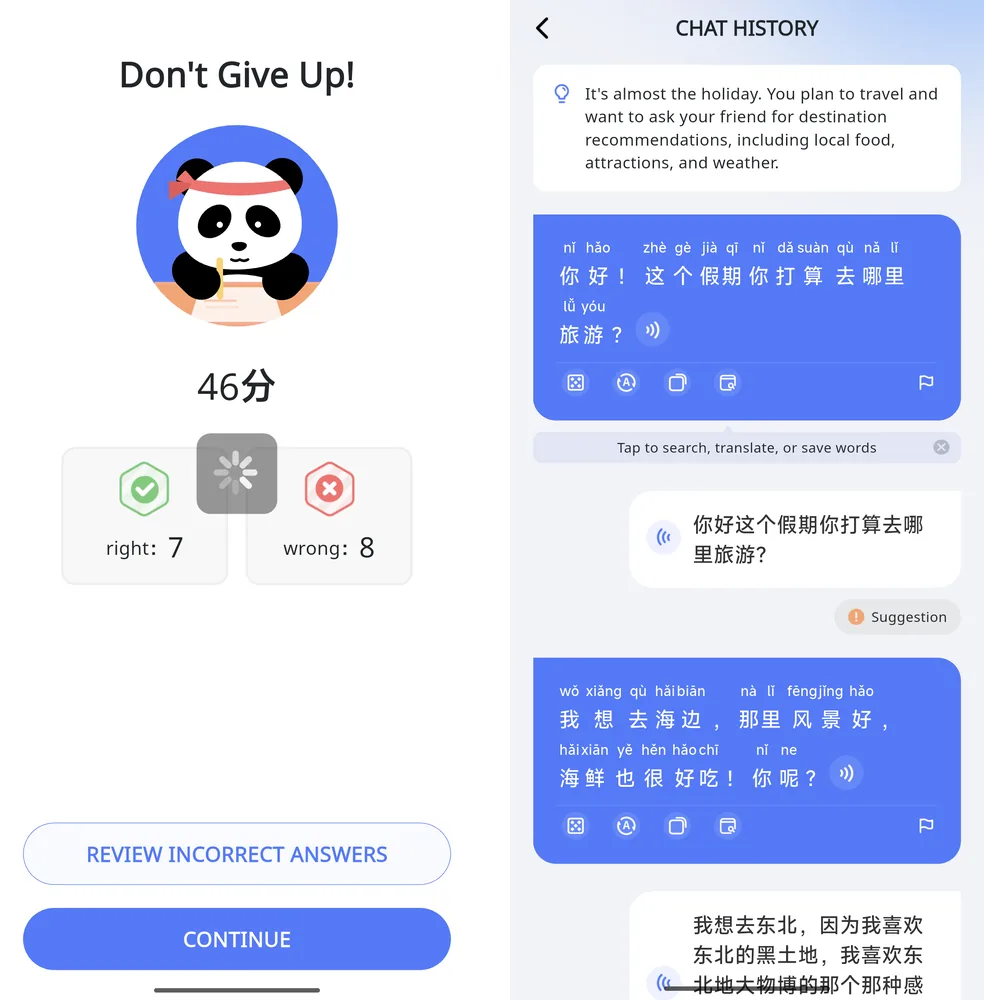
SureChinese gives you two ways back. Every lesson ends on a results page that splits right from wrong (mine said right 7, wrong 8, and "Don't Give Up!") with a "REVIEW INCORRECT ANSWERS" button, so the misses are one tap away while they are still warm. Every Talk conversation keeps a full Chat History with the task at the top, every turn, and the feedback tags, and you can still tap any word in it for a quick meaning a week later.
4. Tasks that ask more of you as you go
Early tasks can hold your hand. Later ones should make you dig the words out yourself.
Line up three SureChinese tasks and you can see the ramp. A video question asks you to recognize the word a teacher just said. A sentence-building task gives you 你好,我是可可。 and three English tiles to put in order. A Talk scenario takes the tiles away and asks you to say the line yourself, to a partner who will answer back and expect you to keep going.
5. Feedback that changes your next attempt
Marking an answer wrong is not feedback. Telling me what to do differently is.
In Talk, every reply I sent got a tag: green "Grammar" when it landed, orange "Suggestion" when there was a better way to say it. Tapping one opens a panel with a Grammar tab and a Pronunciation tab. The Grammar tab showed my sentence, a cleaner rewrite I could practice on the spot, and a note in English. The note was about punctuation: put a question mark after 景点 so the statement ends before the new question about the weather begins. Specific enough to fix in five seconds, which is the only kind of feedback that works.
The Four Jobs an App Can Have
The spine
Owns the sequence, introduces the core language, brings it back, and raises the bar. If I put every other app down for a week, this one still tells me what to do tomorrow. That is the whole test.
The dictionary
Answers one question: what does this mean, how is it said, how is it used? Useful every day, but a search history is not a curriculum, and I stopped letting mine set the agenda.
What surprised me is how much of the dictionary job the spine now does on its own. In a Talk conversation, tapping a word in the partner's message pops up a quick meaning. One toolbar button shows the whole message in English. "Example" offers three ready-made replies with translations, and "Translation" lets me type in English and see it in Chinese before I send. I still keep a proper dictionary for when I want every sense of a character and a dozen example sentences. I open it a lot less.
The input source
Listening and reading at your level, in bulk. This is where a graded reader or a podcast belongs, and where a lot of learners overbuy.
SureChinese builds a small version of this into Talk. A blur button hides the Chinese text of the partner's message, so you have to rely on your ears. The settings gear drops the audio to 0.5x or pushes it to 1.75x. On day one I had the blur off and the speed at 0.5x. By the end of the week I was listening blind at normal speed and reading only when I got lost. Same conversation, tuned to me.
The specialist
Handwriting, tones, exam questions. Bring one in when you have spotted a real weakness, and let it go when the weakness is gone. A specialist that starts handing out daily homework has forgotten its job.
How SureChinese Holds the Spine Together
SureChinese is backed by New Oriental Education and runs on iOS and Android. What makes it work as a spine is that study and use live in the same app. The HSK 1–4 course teaches the language; the Talk tab makes you spend it the same day.
The company describes the speaking side as the Spiral Speak Method, four stages that get progressively less scripted:

Echo is listen and repeat. One model, one job. The read-aloud tasks in every lesson live here.

Choice means picking a reply and saying it out loud. The support is still there, but now you decide.
Mini-Dialogue is a short back-and-forth. You have to follow the other turn and answer in context.

Free Talk is your own words. That is the Talk tab, where one scenario opens each day and the next unlocks at midnight. When you have said enough, an "End Course" button appears and hands you a Study Report: stars, Practice times, Pronunciation Accuracy, Used Words, a Speaking Score Breakdown into Precision, Fluency, and Completeness, and the best sentence you said.
New Oriental's own launch article for the product describes the same design: step-by-step courses, real-life scenarios, AI conversation, and feedback on pronunciation and expression. The short version: work through the sequence, then put its language to work, and never leave the app to do either.
You can start for free. The free plan covers the first unit of the main course and one Talk scenario a day, with an energy budget for AI replies that refills when you check in. The full HSK 1–4 path, unlimited conversation, and the AI feedback features sit behind a subscription. Know that before you hand any app the spine job.
What My Week Looks Like Now
I do not run a study plan anymore. I run a loop, and the app runs most of it for me.
I learn whatever lesson is open on the map. I retrieve by doing yesterday's read-aloud tasks again before I look at anything new. I speak in the day's Talk scenario, hints allowed. I review from the results page and the Chat History, not from a deck I have to maintain. And I transfer by taking the sentence the app just taught me and saying it to somebody else, or at least to the AI partner with a different name in it.
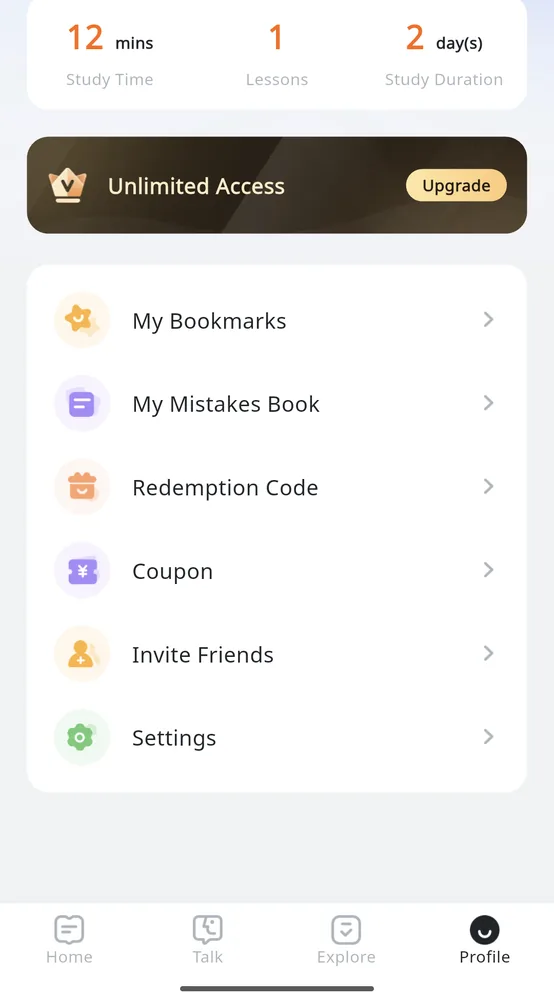
The Profile page keeps me honest. It tallies Study Time, Lessons, and Study Duration in days, and it holds the two lists I actually reopen: My Bookmarks and My Mistakes Book.
Before You Make Any App Your Spine
Ask it these, and be honest about the answers:
- Does it tell me where I start and what comes next, without me configuring anything?
- Does one lesson touch listening, speaking, reading, and writing?
- Does yesterday's language show up in today's lesson?
- Can I get back to my mistakes in one tap?
- Does it make me produce language, out loud, on my own?
- When I am wrong, does it tell me what to change?
- Can I see where the free part ends?
- Will it still be my main path six months from now?
No app aces all eight. The spine has to be strong on the first five.
How Multi-App Setups Fall Apart
I have watched mine fall apart three ways. Two apps introducing unrelated new material on the same day, so nothing gets reviewed. Setup replacing study, where organizing decks and streaks eats the twenty minutes I had. And the worst one, switching apps the moment practice gets hard, because novelty feels like progress and is not.
The fix is one rule. The spine decides the next unit. A satellite may add practice for that unit or patch a weakness I have actually seen. If it does neither, it goes.
Frequently Asked Questions
Can one Chinese app be enough?
For daily study, yes, if it owns the sequence, teaches all four skills, brings material back, makes you speak, and tells you what to fix. You may still want a full dictionary for deep lookups, a teacher for stubborn problems, and official mocks if you are sitting an exam.
Is an HSK-aligned path useful if I am not taking the exam?
Yes. HSK levels are a sensible order for vocabulary and grammar whether or not you ever sit the test. Just make sure you also practice the language for your own situations, which is what the Talk scenarios are for.
How many Chinese learning apps should I use?
One spine and only the satellites that have a named job. Two well-chosen tools beat five that overlap.
What makes a learning path adaptive rather than random?
Adaptive means the app responds to your level and your mistakes while keeping the sequence visible. Random means it just changes the activity. If you cannot see why today's lesson follows yesterday's, it is random, however clever the algorithm.
When do I still need a teacher?
When the same mistake keeps coming back and the app's note is not enough, when you need someone to hold you to a schedule, or when you want a human judgment on your writing. SureChinese covers the daily practice; it does not replace that hour with a good teacher, and it does not try to.
The Bottom Line
The best structured Chinese setup is not the longest app list. It is one app that owns the next step and a few tools that know their place. With SureChinese, the HSK 1–4 map ties the four skills together inside each lesson, and the daily Talk scenario turns that material into conversation with a note on what to fix. Add satellites when they solve a specific problem. Keep one answer to the morning question: what do I learn today?
Learn Chinese. Actually speak it.
Follow a structured path, then put each step to work with AI speaking practice. Start for free on iOS or Android.