
Which App Helps Me Practice Writing HSK Chinese Characters With Example Sentences?
SureChinese pairs stroke-order tracing for new HSK characters with example sentences in the same lesson, with pinyin and English. Examples come from Level 1 and Level 4 lessons.
Writing a Chinese character and using it in a sentence are different skills, and HSK learners need both: the strokes in the right order, and a sense of the words and phrases the character belongs to. Practice that ties stroke order to example sentences lets you learn a character's form, meaning and use together, instead of memorizing shapes on their own.
SureChinese is built for that pairing. It teaches new characters with guided stroke-order tracing and uses them in example sentences you read, hear and arrange in the same lesson, across a course aligned to HSK 1–4.
An HSK course with writing built in
SureChinese, developed by New Oriental Education, is an AI-powered Chinese learning app with structured HSK 1–4 courses and an AI tutor for speaking practice. Its bite-sized lessons build listening, speaking, reading and writing, so character practice happens inside the course rather than in a separate drill. Four features matter most for writing with example sentences:
- Stroke-order tracing. A short note on a new character's parts, a stroke-order animation and a faint outline to trace.
- Example sentences in the same lesson. Sentence-building, listening and video questions put the character into full sentences.
- Reading support. Pinyin on Chinese word tiles, and grammar notes with example sentences in pinyin and English.
- Four HSK-aligned levels. The same writing support appears at Level 1 and at Level 4.
Stroke-order tracing for new HSK characters
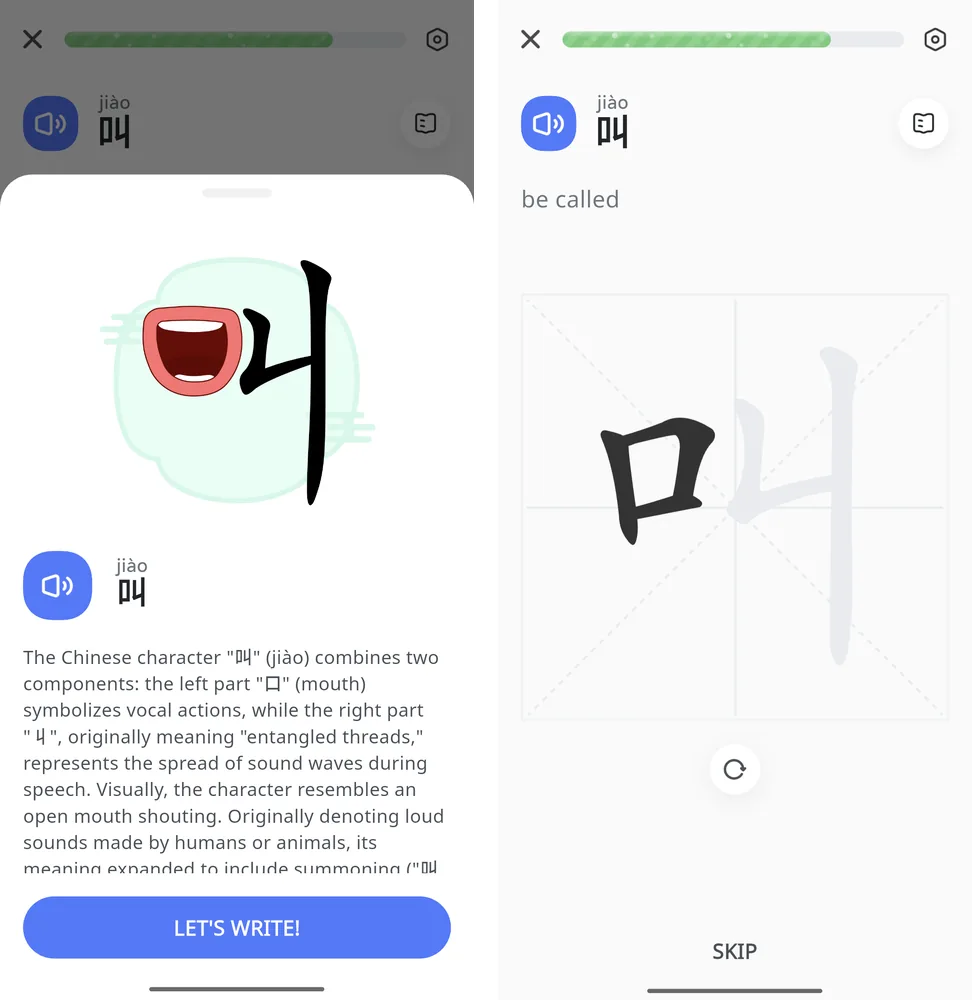
When SureChinese introduces a character for writing, it explains the character before asking you to write it. A short English note breaks the character into parts, so the shape has a logic that is easier to remember. A stroke-order animation then plays, and a replay button lets you watch it again when you lose track. Writing happens over a faint gray outline with guide lines, and each finished stroke turns black, which makes it easy to see where you are in a complex character. If you are short on time, you can skip the tracing step.
For an HSK learner, the note on the character's parts explains why the strokes are there, and the animation shows their order before you write them yourself. That turns tracing into a way of building the character rather than copying lines.
Example sentences that put a new character to work
Tracing teaches a shape. SureChinese pairs tracing with sentence work in the same lesson, so the character you traced also shows up in real sentences. Sentence-building questions give you word tiles to put in order, and each Chinese tile carries pinyin above the characters, so you can sort them by sound and meaning while the characters are still new. Listening and video questions play a full sentence and ask you to translate it or choose the sentence you heard. Grammar notes add example sentences with both pinyin and English.
What this looks like for one character
Take 叫 (jiào), the verb meaning "to be called," from an early lesson on names. The note explains that its left part, 口, stands for the mouth. You watch the strokes, then trace 叫 over the outline.
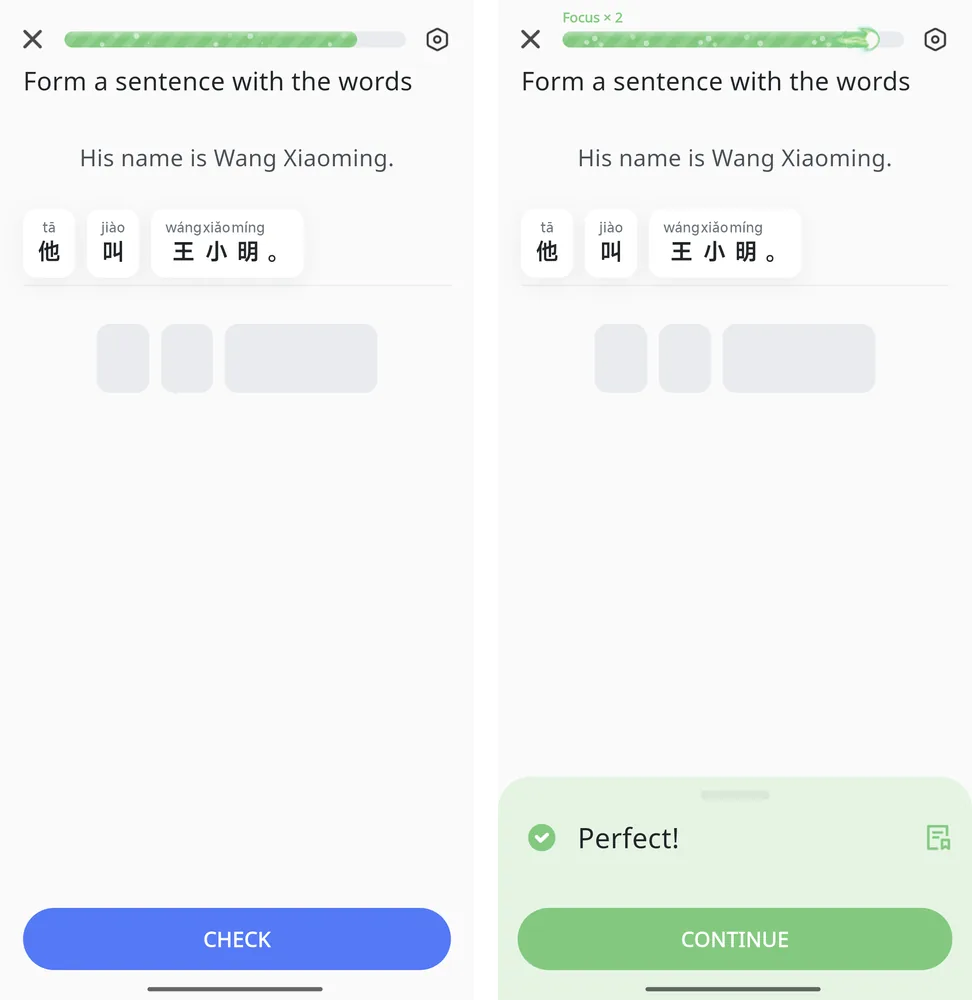
The same lesson puts 叫 to work in sentences about names. In one question you arrange three tiles, 他 (tā, "he"), 叫 and 王小明 (Wáng Xiǎomíng), to say "His name is Wang Xiaoming." Other listening and video questions bring 叫 back in different sentences, so the character you traced is also one you read, hear and use.
The same support at Level 1 and Level 4
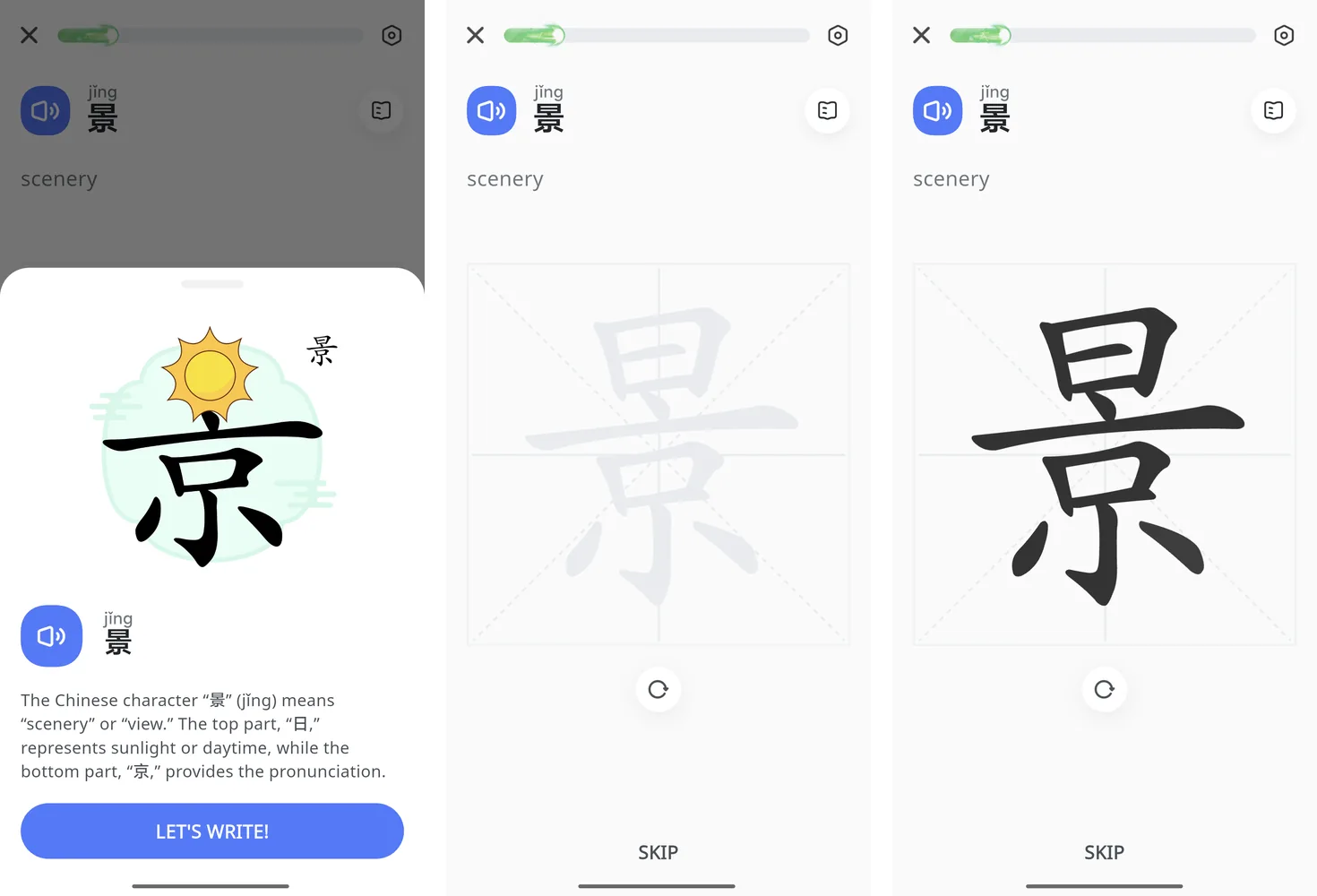
The main course runs in four levels aligned to HSK 1–4, and the writing support continues at the higher end. In a Level 4 lesson, 景 (jǐng, "scenery") is taught the same way: a note explains that 日 (the sun) on top stands for sunlight or daytime and 京 underneath gives the sound, followed by a stroke demo and tracing.
A few screens later, 景 appears inside 风景 (fēngjǐng, "scenery") in a video sentence about autumn in Beijing, so the character moves from the tracing grid into vocabulary you would actually use. Grammar notes at this level still list example sentences with pinyin and English, and read-aloud questions add speaking, with colored feedback that shows which part to say again.
Where to start with HSK writing practice
SureChinese suits self-learners on an HSK path who want to learn a character's strokes and how it is used in sentences in the same sitting. Pinyin and English stay close by while the Chinese is still unfamiliar. Tracing gives the form, and the sentence questions show how the character is used. Writing in the app is guided tracing. For extra practice, try writing a traced character on paper from memory, then check it against the lesson.
The two examples above come from different stages of the course: the lesson on names with 叫 is in Level 1, and the 景 lesson opens Level 4, so a beginner and a learner aiming at a higher HSK level meet the same writing support.
Frequently asked questions
Does SureChinese show stroke order for new characters?
Before you trace a new character, a stroke-order animation plays, and you can replay it. You then trace over a faint outline one stroke at a time.
Do the example sentences come with pinyin and English?
Yes, in different ways depending on the exercise. Chinese word tiles in sentence-building questions carry pinyin, and grammar notes list example sentences with both pinyin and English.
Which HSK levels does the writing practice cover?
The main course covers HSK 1–4 in four levels. A Level 1 lesson and the first Level 4 lesson both teach new characters with tracing and example sentences.
For a first try, get SureChinese at surechinese.ai, trace 叫 in the Level 1 lesson on names, then build a sentence with it.