
How Should a Complete Beginner Start Learning Chinese From Zero?
How to start learning Chinese from zero: learn the sounds and first words side by side, speak from day one, and keep going with a leveled course. Includes a four-week routine.
Starting Chinese from nothing means doing three jobs at roughly the same time: learning to hear and spell the sounds, connecting a first set of words to their sounds and meanings, and saying things out loud. Many beginners stall because they treat these as a strict sequence. Some spend weeks on sound charts before learning a single useful word; others memorize word lists they cannot pronounce and never say any of it to anyone. A better start runs the three side by side in short daily sessions, handles tones from the very first word rather than saving them for later, and uses a leveled course so each week builds on the last.
SureChinese puts all three jobs in one app, so a complete beginner can work on the sounds, the first words and speaking out loud in the same short session from the first day.
Where SureChinese fits in a first month
SureChinese combines HSK-leveled courses, from HSK 1 to HSK 4, with speaking practice led by an AI tutor. For complete beginners, SureChinese starts from zero with pinyin and your first words, and three parts of the app handle the three jobs:
- A separate Pinyin Course. Short lessons on initials, finals, tones and pinyin rules, for working on sounds alongside vocabulary.
- Beginner course lessons. First words with audio, pinyin, pictures and quick questions, plus read-aloud practice that gives a score and colors the characters.
- AI conversation practice. Conversations with an AI tutor that offer a suggested reply when you do not know what to say.
Learn the sound system in small pieces
A Mandarin syllable has a final and a tone, and most syllables also start with an initial consonant. Pinyin is the standard way of spelling those sounds with the Latin alphabet, and it is the bridge you will lean on for months, so it is worth learning properly. Some spellings look familiar but sound different from English: q is close to the "ch" in "cheese," x is somewhere near "sh," and zh, ch and sh are said with the tongue curled further back. The letter ü has no English equivalent; it is an "ee" said with rounded lips. Learning these few early saves a lot of confusion when reading pinyin later. Keep the beginner's guide to pinyin nearby as a reference while the spellings settle in.
The part that catches beginners out is tone. Mandarin has four main tones plus a neutral one, and changing the tone changes the word. The classic example is the syllable ma: mā with a high, level tone means "mother," má rising means "hemp," mǎ dipping means "horse," and mà falling means "to scold." You do not need to master all of this before learning anything else. What matters is to treat the tone as part of every word from the start, the way you would treat a vowel in English. A word learned without its tone has to be relearned later.
A few habits make tones easier:
- Listen to pairs of syllables that differ only in tone, and try to say which is which before checking.
- Learn new words with their tone marks visible, and say them out loud as you read them.
- Expect changes in connected speech. Two third tones in a row, as in nǐ hǎo ("hello"), are said as ní hǎo, and a handful of common words shift in similar ways.
To practice hearing each tone on its own, work through the four tones and how to hear them.
Spread this over the first weeks rather than cramming it. A few minutes on a small set of sounds each day, alongside new words that use those sounds, keeps the sound system connected to real vocabulary.
First words with sound, meaning and picture together
The first few dozen words carry a lot of weight: greetings, "I," "you," names, countries, numbers, simple verbs such as "to be" and "to be called." Learn each one as a package of sound, tone, meaning and, eventually, character.
A practical first set looks something like this:
- Greetings. Hello, goodbye, thank you, sorry.
- People. I, you, he, she, we, plus the word for "to be."
- Introductions. Your name, where you are from, the verb "to be called."
- Numbers. One to ten, which also teach you a range of tones in short syllables.
- Simple questions. Who, what, where, and the particle that turns a statement into a yes-or-no question.
That is enough to introduce yourself and ask someone else the same questions, which makes it a natural first conversation. Hearing the word, seeing its pinyin and matching it to a picture all at once makes it easier to recall than a line on a list.
Characters can come gradually. You do not need to write hundreds of them before you speak, but it helps to start recognizing the ones you meet most often, because they repeat constantly. Many common characters are built from a few recurring parts, and learning what those parts mean makes new characters easier to remember. For help balancing the two in your first weeks, read pinyin versus characters.
Short questions are a quick way to test these words early: pick the picture that matches a word, choose the sentence you heard, put a few words in order. Each one takes seconds and shows immediately whether the word has stuck.
Say things out loud from the first day
Beginners tend to put off speaking, and the longer it waits, the harder it gets. The fix is to start small and build in steps. First repeat words and short sentences after a model, paying attention to tone. Then answer simple prompts by choosing a reply and saying it. Then try short back-and-forth exchanges with familiar phrases. Finally, answer in your own words, even if the sentences are short.
The first three steps hand you ready-made phrases, so by the time you answer in your own words, you already have material to draw on. Recording yourself and comparing it with the model is especially useful for tones, since it is hard to judge your own pitch while you are speaking.
Practicing sounds, words and speaking with SureChinese
For sounds, the Pinyin Course is a separate track you can select next to the main course. Its units run from initials and finals through the tones to pinyin rules.
For first words, Level 1 of the main course starts with greetings, names, and countries and nationalities. Its lessons present words through labeled photos, audio questions, word-order exercises and sentences to read aloud, so new words are seen and heard, and many of them are said aloud in read-aloud questions. In the read-aloud questions, you see the sentence with pinyin and English and hear a model recording. After you speak, the app gives a score, colors the characters and lets you replay your own recording. Playing your recording right after the model makes it easier to hear where your tones match and where they drift.
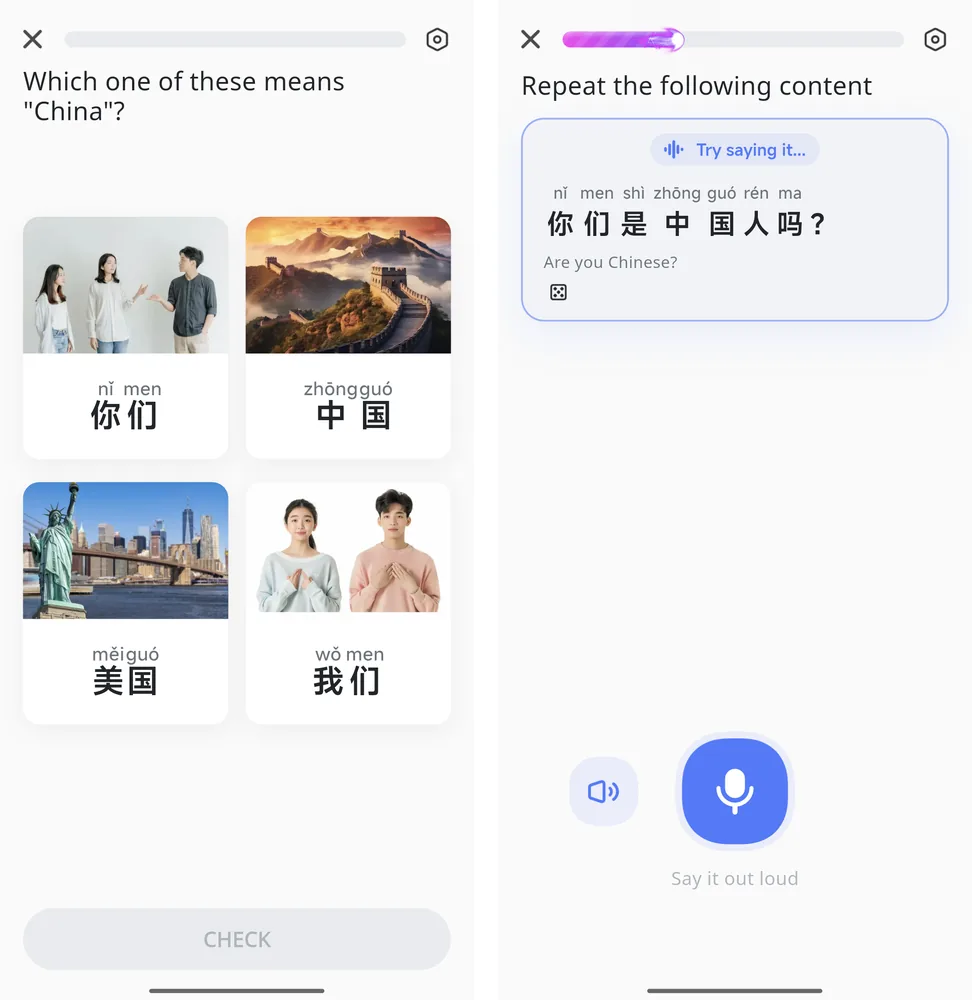
For speaking, SureChinese follows the Spiral Speak Method: Echo (repeating words and phrases), Choice (speaking by choosing a reply), Mini-Dialogue (short exchanges inside lessons) and Free Talk (conversations in your own words with an AI tutor). The first three sit in the courses, and Free Talk happens in the conversation lessons. In those conversations, the tutor's lines show pinyin and English, and a suggestion card offers a short sentence you can say, so even a first conversation gives a beginner words to work with.
A simple routine for the first four weeks
A steady pattern of short daily sessions is easier to keep up than occasional long ones.
- Week one. Spend part of each session on a small set of sounds and tones, and the rest on greetings and introducing yourself. Say every new word out loud.
- Week two. Keep a few minutes of sound practice, and add names, countries and "to be." Start repeating whole short sentences and recording yourself.
- Week three. Begin answering simple questions in full sentences, using phrases you already know. Start recognizing the characters that keep coming up.
- Week four. Try a short conversation in a familiar situation, such as introducing yourself or saying where you are from, and review the words you keep missing.
By the end of the month, the aim is not fluency. It is a working sound system, a small vocabulary you can actually say, and the habit of speaking every day. Most of the words in this first month already belong to HSK 1, the first level of the exam and of SureChinese's main course, so the next step is to keep working through the rest of that level. From there, the study plan for HSK 1 and 2 lays out the next stage.
Who this way of starting suits
This approach suits adults learning on their own with no Chinese background, whether the goal is travel, family, work or an exam later on. It favors short, frequent practice over long weekend sessions, and it puts speaking in from the first week rather than after the grammar. Learners with a teacher or a class can use it too, as the daily practice between lessons. In SureChinese, that means running the Pinyin Course and Level 1 of the main course side by side, with a conversation lesson whenever you want to try your new words on the AI tutor.
Frequently asked questions
Should I learn pinyin or characters first?
Start with pinyin, but do not wait long before characters. Pinyin lets you hear, say and look up words from the first day. Characters can follow gradually, beginning with the ones that appear most often in your first lessons.
How long before I can hold a basic conversation in Chinese?
With daily speaking practice, short exchanges about yourself, such as your name, where you are from and what you do, are a realistic early goal. For the longer view, see how long it takes to learn Chinese.
Can I start learning Chinese from zero on my own?
Self-study works when it covers sounds, words and speaking together. A structured course keeps the order clear, recording yourself helps with tones, and an AI conversation partner gives you somewhere to use what you learn when no one else is around.
Do I really need to learn tones from the beginning?
Learning tones from the first word saves a great deal of relearning later. Tones are part of each word's identity in Mandarin, so treating them as optional early on means correcting habits that are already set.
Start with one sound lesson and one beginner lesson in SureChinese, and say each new word out loud before you move on.