
What App Teaches Everyday Mandarin Vocabulary for Real-Life Conversations?
SureChinese organizes Mandarin vocabulary around everyday topics such as food, directions, and shopping, then helps learners use those words in scenario-based conversations with an AI tutor. Suggested replies and feedback support learners as they practice expressing themselves in Mandarin.
Many learners can remember words for food or transportation but struggle to retrieve them when they need to ask a question. Memorizing individual words does not always make them easy to recall in conversation. Meeting words in context, hearing them, and using them in your own replies can help bridge that gap.
SureChinese combines structured Chinese lessons with scenario-based AI conversations. Its everyday topics give learners a starting point for building vocabulary, while speaking practice offers opportunities to use those words for practical purposes.
Everyday topics, then conversation practice
Backed by New Oriental Education, SureChinese pairs structured HSK 1–4 courses with AI speaking practice. Its conversation scenarios include Travel & Life and Daily Communication.
For learners working on everyday vocabulary, useful features include:
- Lessons organized around everyday topics. Subjects such as family, food, transportation, and shopping help learners explore related vocabulary.
- Vocabulary practice with audio and visual support. Short activities connect Chinese words with their pronunciation and meaning.
- Scenario-based conversations with clear tasks. Practice choosing words to ask questions, explain preferences, or discuss plans.
- Suggested replies. Use an example as a starting point when you are unsure how to respond.
- Feedback on spoken responses. Review pronunciation and grammar feedback to choose a focus for further practice.
Vocabulary organized around everyday situations
Topic-based lessons give related words a shared context. Vocabulary about food and drinks, for example, can help you discuss what you would like to order. Words about family can help you introduce relatives, while time expressions support conversations about routines and plans.
SureChinese's beginner lessons cover everyday subjects such as family, food and drinks, locations and directions, shopping, and weather. Check the course map for the topics available at your level, then choose an area that fits something you would like to say in Mandarin.
Within a topic, think about a small communication goal. For food, that might be naming a drink and saying what you prefer. For transportation, it might be asking whether you can reach a destination by subway. A clear goal gives you a reason to recall the words together.
Related vocabulary is a starting point. To make it easier to use, practice the words in short phrases and sentences as well as individually.
Connecting words with sound and meaning
Spoken vocabulary involves more than recognizing a written word. You also need to recognize it when you hear it and retrieve it when you want to speak.
SureChinese's course activities combine audio, meanings, and visual material. Listening questions ask learners to identify what they hear, while read-aloud exercises provide a way to practice saying sentences.
When learning a new word, listen to the model audio and repeat it before moving on. Use pinyin as a pronunciation aid, then listen to how the word sounds in a complete sentence. Pay attention to its tones and rhythm as well as its meaning.
After a read-aloud attempt, use the feedback to choose a short section to review. Listen again, practice the phrase, and return to the complete sentence.
Using vocabulary in scenario-based conversations
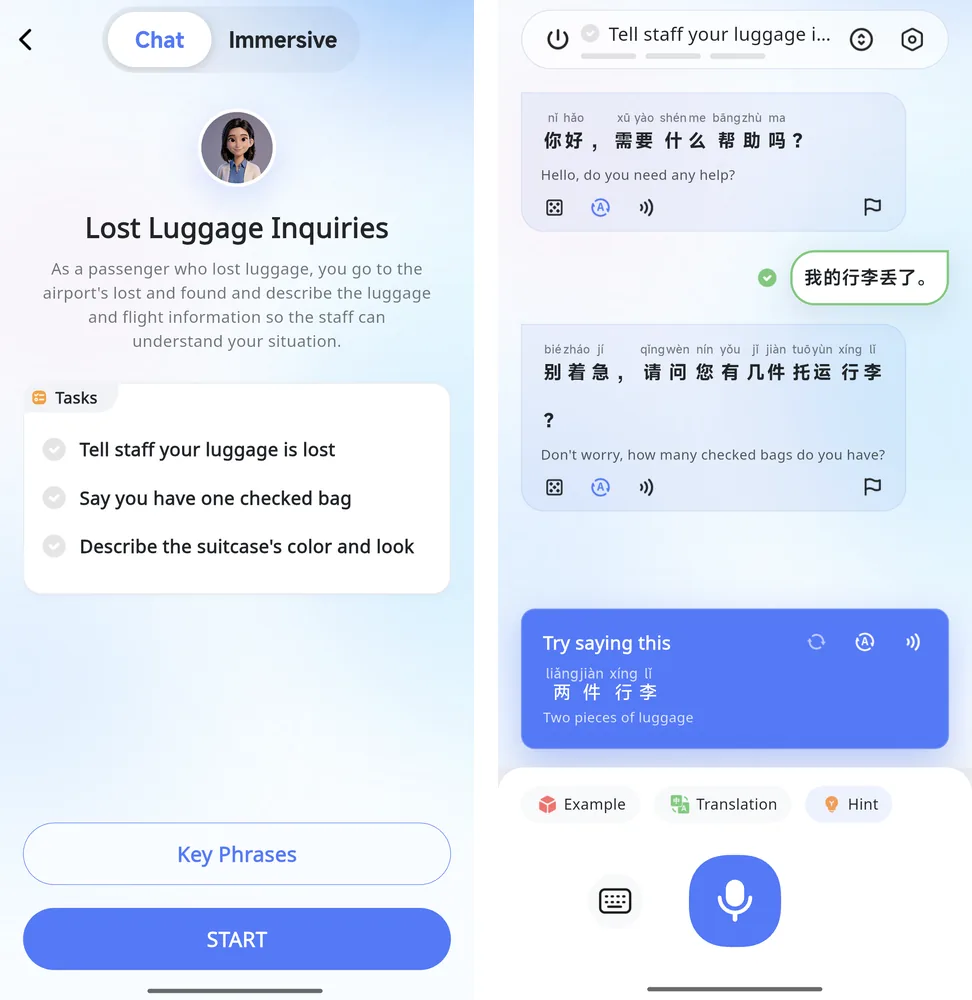
SureChinese's Talk lessons use scenarios and communication tasks to give the exchange a purpose. The AI tutor takes the other role, and you respond by speaking or typing. The app offers Chat and Immersive modes for conversation practice.
A tourist attraction inquiry is one example of how a scenario can bring everyday vocabulary together. Asking about a destination may involve a place name, a transportation phrase, and a question about visiting times.
Useful expressions for this kind of exchange include:
- 景点 — jǐngdiǎn — tourist attraction
- 我想去故宫。— Wǒ xiǎng qù Gùgōng. — I'd like to visit the Forbidden City.
- 坐地铁 — zuò dìtiě — take the subway
- 可以坐地铁去吗?— Kěyǐ zuò dìtiě qù ma? — Can I get there by subway?
- 几点开门?— Jǐ diǎn kāimén? — What time does it open?
These are examples of language you might use in a travel conversation. Adapt them to the question you are answering rather than treating them as a fixed script.
If you have recently learned transportation words, choose a conversation where you can try them. Course lessons and Talk scenarios can complement each other, but the topics may not always match automatically.
Getting help when a word will not come
Running out of words during a conversation is normal. SureChinese offers support such as translations, hints, and suggested replies to help you continue.
Use a suggestion to understand how an answer can be formed, then adapt it where possible. For example, replace the destination with somewhere you want to visit or change the time to match your own plans. This turns an example into practice expressing your own meaning.
Check the conversation settings for the text and translation options available in your version of the app. As you become more comfortable, try answering before opening a hint or reading a suggestion.
The aim is to use support when it helps you understand or continue the exchange, while giving yourself opportunities to retrieve familiar words independently.
Reviewing grammar and pronunciation
Using words in your own sentences can reveal difficulties that are less obvious during vocabulary recognition exercises. SureChinese provides grammar and pronunciation feedback in Talk to help learners review their responses. Check the current subscription details for access to specific feedback features.
A grammar point to watch: future plans and 了
Consider the sentence 我后天去了天安门. As a standalone statement of a future plan, a more natural version is:
我后天去天安门。
Wǒ hòutiān qù Tiān'ānmén.
I'm going to Tiananmen the day after tomorrow.
The important point is not that 了 can never appear with a future time expression. It is not a general past-tense marker, and its use depends on the sentence structure and context.
For example, 了 can appear when one future action is presented as completed before another:
我后天去了天安门以后,再去故宫。
Wǒ hòutiān qù le Tiān'ānmén yǐhòu, zài qù Gùgōng.
After visiting Tiananmen the day after tomorrow, I'll go to the Forbidden City.
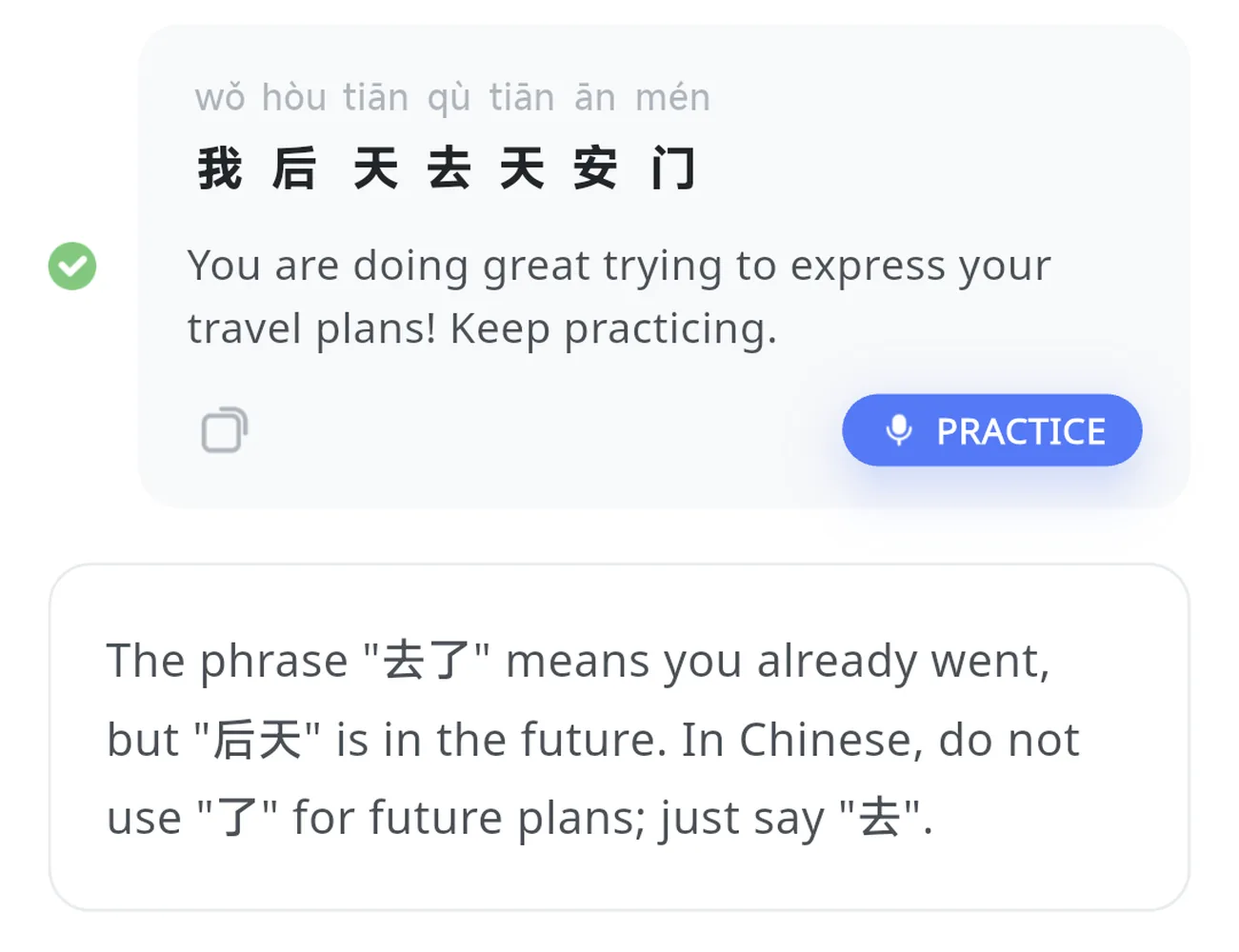
When reviewing an automated correction, consider the complete sentence and the meaning you intended. A correction can offer a useful model, but a short explanation should not be treated as a rule for every context.
Using pronunciation feedback
Spoken replies in Talk receive feedback using scores labeled Accuracy, Fluency, and Completeness. Review the app's explanations alongside your recording to decide what to practice next.
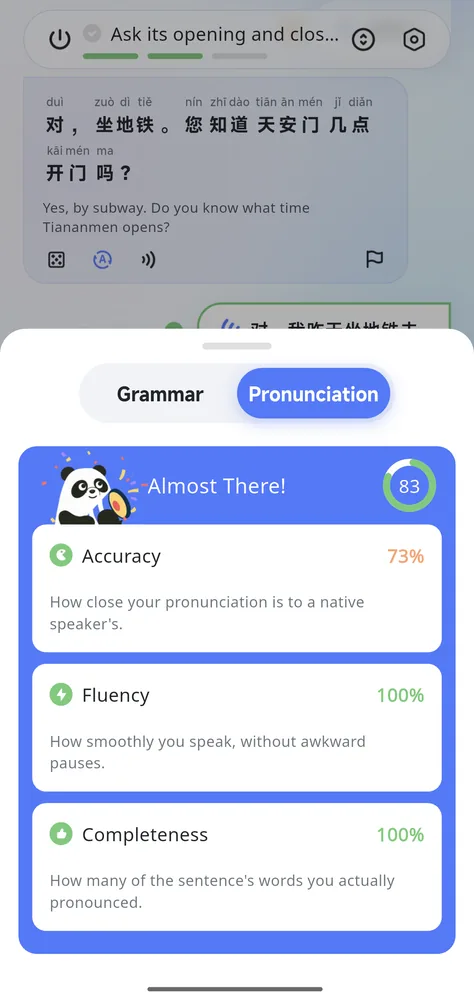
For example, after using 坐地铁 in a reply, listen to how you pronounced the phrase and how it fits into the sentence. You might choose to practice a difficult syllable or try saying the complete response more smoothly.
Treat a score as one piece of feedback about an attempt. It does not, by itself, show whether you can use the word confidently across different conversations.
Building a vocabulary routine around your lessons
A simple routine connects learning, speaking, and review:
- Choose a few useful words from a lesson. Focus on words you can imagine using in your own life.
- Listen and say them in a sentence. Review the audio and practice a short phrase or example sentence aloud.
- Choose a relevant Talk scenario. Look for an exchange where those words fit naturally.
- Answer in your own words. Use a suggestion when you need help, then try adapting it.
- Review one response. Listen back, check the feedback, and choose a word or phrase to practice again.
Use the conversation review to revisit individual replies. You can also replay a completed lesson and try answering with less support or a different choice of words.
If a word was missing from your first attempt, learn the phrase you needed and use it when you return to the scenario. Repeated use in meaningful sentences can help make the word easier to retrieve.
Who this kind of practice can help
This approach can be useful for beginners and learners working through HSK 1–4 material who want more opportunities to use vocabulary in everyday exchanges.
Travelers might start with destinations, transportation, food, and shopping. Learners who use Mandarin in daily life may prefer topics related to routines, family, or local services. Choose according to the conversations you expect to have.
SureChinese brings structured lessons and AI speaking practice together, giving learners a way to explore vocabulary and then try it in conversation. The benefit depends on how you use that opportunity: listening carefully, answering aloud, and returning to language that was difficult the first time.
Frequently asked questions
What everyday topics does SureChinese cover for beginners?
Beginner lessons cover topics such as family, food and drinks, locations and directions, shopping, and weather. Check the course map for the current unit names and lesson content at your level.
Are the AI conversations based on real-life situations?
Yes. SureChinese offers scenario-based practice in areas such as travel and daily communication, with tasks that give the conversation a purpose. These are simulated exchanges with an AI tutor.
Does SureChinese help when I do not know what to say?
Yes. Conversation support includes features such as suggested replies, hints, and translations. Use an example as a starting point and try adapting it to what you want to say.
Can I reduce the amount of help as I become more confident?
The app offers options for adjusting on-screen support, including hiding Chinese text. Check the conversation settings for the available controls, and try forming a reply before consulting a suggestion.
Do I get feedback on my spoken Chinese?
Talk provides pronunciation feedback using scores labeled Accuracy, Fluency, and Completeness, as well as grammar feedback. The conversation review helps you revisit individual responses. Check the app for the current availability of specific features and subscription benefits.
Open SureChinese, choose a useful topic, and practice a few words aloud. Then look for a conversation where you can use them and select one reply to review afterward.