
Which Chinese Learning App Teaches Real-Life Mandarin Conversations?
SureChinese teaches real-life Mandarin with scenario-based AI conversations: practical tasks, a tutor that asks follow-up questions, help forming replies, and feedback on every spoken sentence.
A useful phrase can get a conversation started. Keeping it going means understanding the reply and deciding what to say next, often about a detail you didn't plan for. Practice with a clear task, follow-up questions and some help forming a reply lets you work on that part as well.
SureChinese teaches travel and everyday Mandarin through scenario-based AI conversations: you explain what you need, answer the tutor's follow-up questions, and get help with a reply when you run out of words.
What SureChinese brings to real-life conversation practice
SureChinese pairs structured HSK 1–4 courses with AI speaking practice. The courses build vocabulary and grammar, and the Talk section turns them into conversation with an AI tutor. SureChinese describes its approach as the Spiral Speak Method, moving from guided repetition and choosing replies to short dialogues and then to conversation in your own words. The first three stages happen in the course lessons, and Talk is where the free conversation takes place. SureChinese lists travel, daily communication and business among the situations it covers; the Talk lessons described here are travel and everyday scenes.
- Scenario conversations. Each Talk lesson sets up a situation and three tasks, so you know what you need to say.
- Follow-up questions. The AI tutor replies to what you said and asks for another detail.
- Help with replies. Key phrases, pinyin, translations and a suggested reply keep a difficult moment from ending the chat.
- Feedback and replays. Spoken replies are scored, and finished lessons can be run again.
Conversations built around a situation and a goal
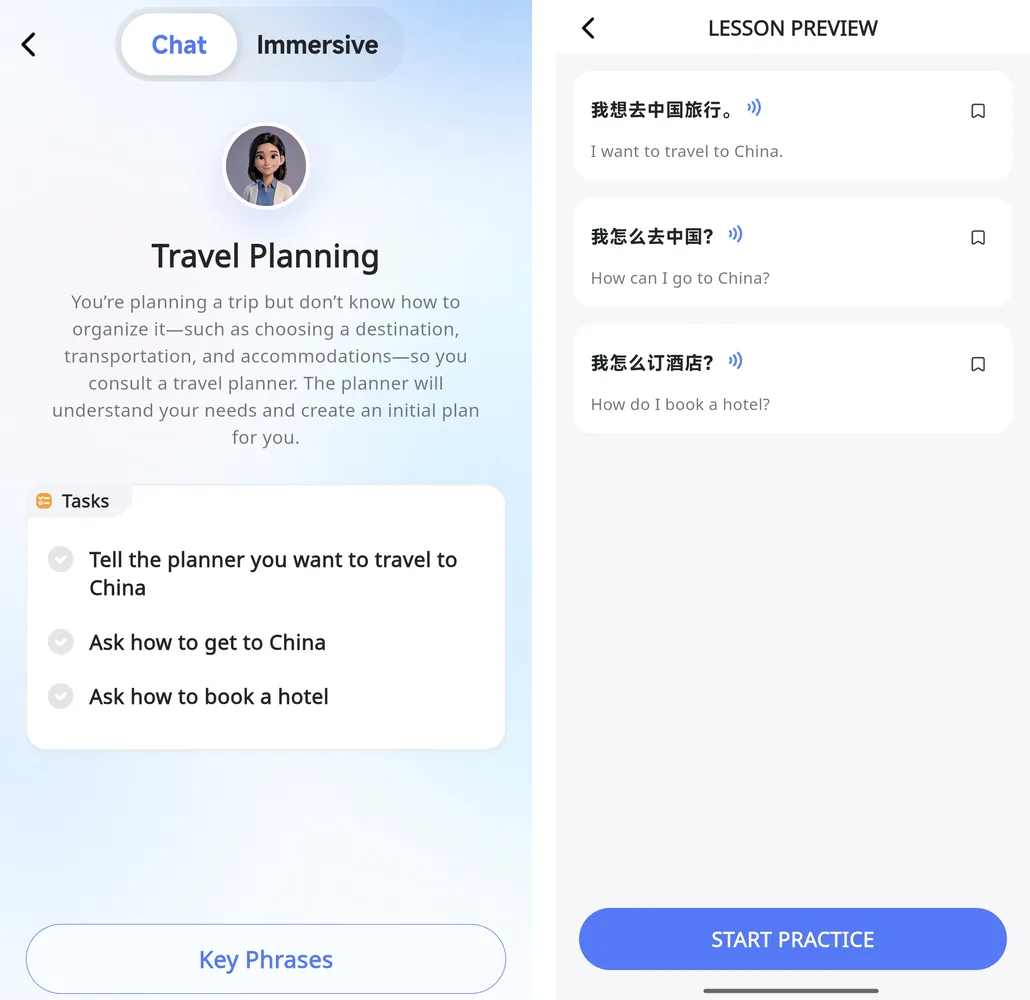
Real-life Mandarin is usually about getting something done: arranging a trip, checking into a hotel, sorting out a problem. SureChinese builds its Talk lessons the same way. Each one opens with a brief description of the situation and three tasks that spell out what you need to get across, so the conversation has a purpose and a clear finish. A progress bar fills as each task is covered, and the app tells you when all three are done.
Before the chat starts, a preview plays the lesson's key phrases with audio and English, so the core sentences already sound familiar. The scenes stay close to the errands a visitor actually runs, such as asking about local sights, checking into a hotel, or shopping at a fruit store or a supermarket. Several lessons deal with harder situations: explaining what went wrong, as when a suitcase goes missing at the airport, goods need to be returned, or an online payment fails. Those are the exchanges where a phrasebook stops helping.
A tutor that asks the next question
A drill ends once you have said the line. In SureChinese, the AI tutor answers what you said and then asks for another detail. That kind of unplanned question is hard to rehearse on your own.
What one conversation looked like
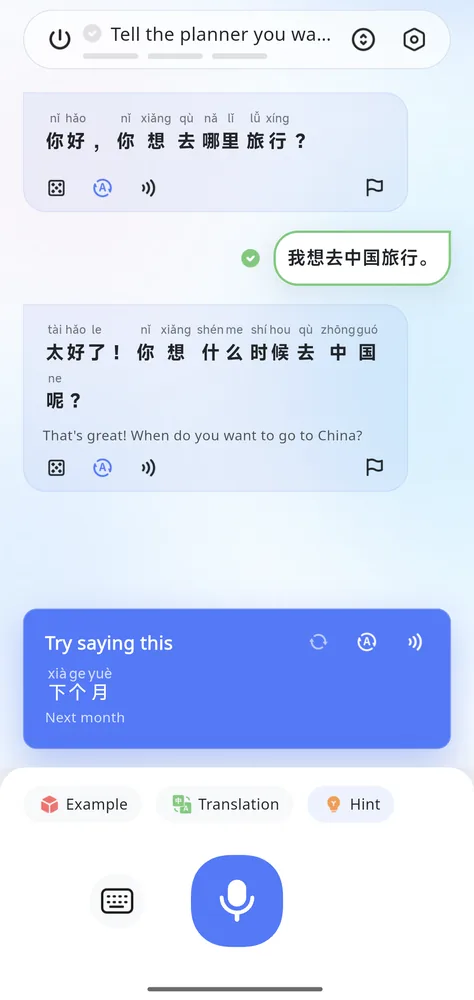
Take a lesson about planning a trip to China. The tutor, Yuan, opened by asking where the learner would like to travel. The learner answered 我想去中国旅行。 ("I want to travel to China."), and in that chat the tutor followed up with 太好了!你想什么时候去中国呢? ("That's great! When do you want to go to China?"). None of the preview phrases covers a date, so answering meant going beyond the sentences prepared before the chat.
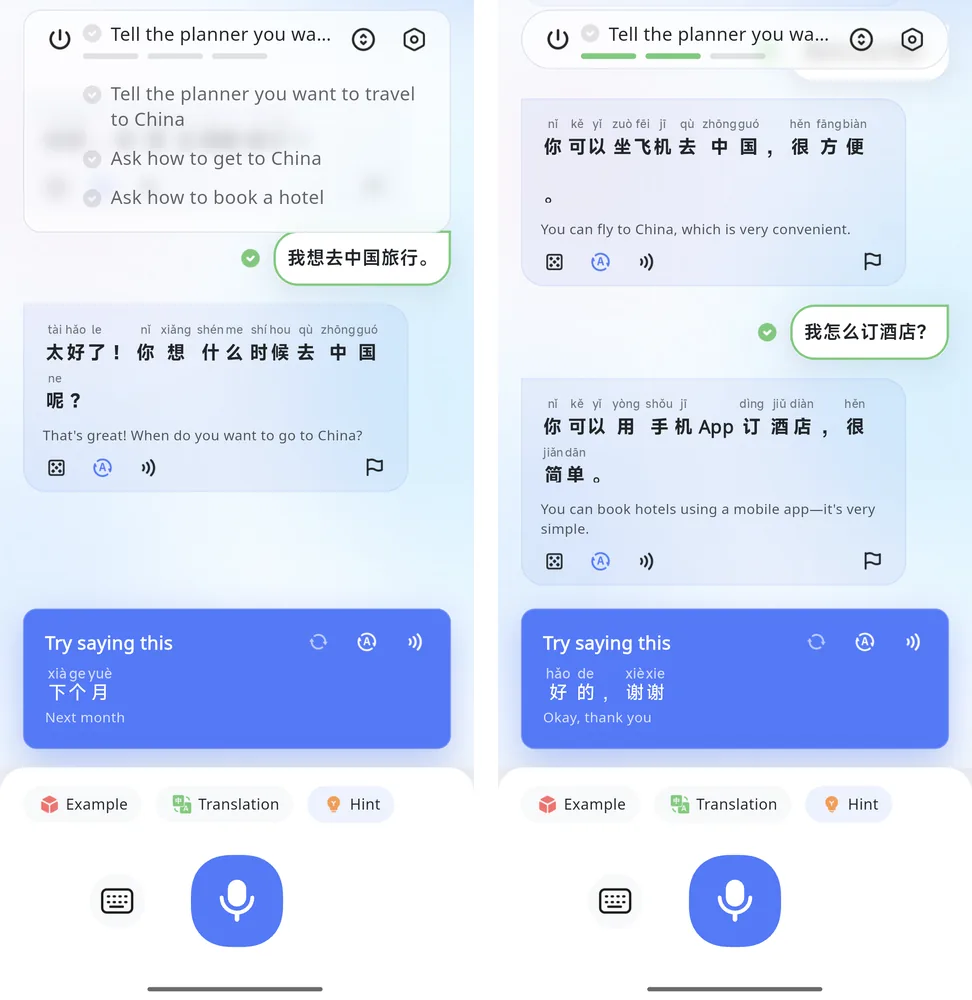
Later turns in that chat also brought in words beyond the preview, such as "plane" and "phone app". Even a closing "OK, thanks" got one more question, about which city to visit. A phrase list cannot prepare you for that part of a real exchange.
Help for the reply you can't form yet
A follow-up question is only useful practice when a learner with a small vocabulary can still answer it, so SureChinese keeps several kinds of help inside the chat. Every tutor message shows pinyin above the characters, with an English translation you can show or hide. A suggested reply offers something short to say, and it can be switched off once you would rather manage without it. A translation box turns a sentence typed in English into Chinese you can send.
In the trip conversation above, the question about dates came with a suggested reply of 下个月 ("next month"), short enough to say right away. When you want more of a challenge, Advanced mode in the chat settings hides the tutor's text and turns off the automatic translation and hints, so more of each answer depends on listening.
Feedback on each reply, and a scene you can run again
Each spoken reply is scored for accuracy, fluency and completeness, and its wording gets a grammar check. After the conversation, a Study Report scores each sentence you spoke, which makes the weakest line easy to find, and lets you play back a recording of your best one.
Lessons you have finished can be replayed. Running the same scene again with less help from the suggested reply is a simple way to build confidence.
Who this kind of practice fits
Put together, these features suit four kinds of learners. Anyone preparing for a trip to China or a longer stay gets scenes built around errands they are likely to run there. Learners who know some Chinese but struggle with follow-up questions can practice answering them, with a suggested reply and translation available when needed. Self-learners without a regular speaking partner get a tutor and reply help built into the chat. Complete beginners can build a base in the HSK 1–4 course and its pinyin lessons, then bring those words into the Talk scenes.
Frequently asked questions
Can beginners practice when they don't know what to say yet?
With support, yes. Each lesson previews its key phrases with audio and English, the tutor's messages show pinyin, a suggested reply offers something short to say, and the translation box turns English into Chinese. Time in the HSK 1–4 course gives you more words to bring to the scenes.
Do I need a live speaking partner?
No. The AI tutor is there whenever you open a Talk lesson, so practice doesn't depend on booking anyone. Practicing with a teacher or a friend still works well alongside it.
Is the conversation practice free?
Partly. Talk is available without a subscription in a limited form, and the subscription page lists unlimited speaking practice under Premium.
Open a Talk lesson in SureChinese, answer the tutor's first question on your own, and see how far the key phrases carry you once the follow-ups begin.