
What Chinese App Teaches Daily Conversation for Travel, Study, and Business?
SureChinese covers everyday Chinese for travel, study and work in one course: from Level 2 to Level 4, each of these situations has its own units, and topics such as the job interview come back at higher levels.
Travel, study and work look like three different kinds of Chinese, and many learners shop for three different phrasebooks. In practice, all three involve the same everyday exchanges: buying things, asking the way, asking for help. Each one also brings its own topics, such as hotels and check-in for a trip, classes and majors for a degree, interviews and office tasks for a job. What to look for, then, is one course that trains the shared core, arranges the specialist topics by situation, and brings the same topic back at a higher level.
SureChinese teaches the Chinese for a trip, a degree and a job in one course arranged by situation. From Level 2 to Level 4, travel, campus and workplace topics each have their own units, and a topic such as the job interview returns in the units of higher levels.
Travel, campus and office Chinese share a core
Whatever brings you to China, the first conversations look similar. You pay for something, find your way somewhere, and ask someone to help. The differences appear one layer up:
| Situation | Everyday exchanges you will have | Topics of its own |
|---|---|---|
| Travel | Shopping, paying, asking directions, asking for help | Tickets, flights, check-in, hotels |
| Study | The same everyday exchanges | Classes, majors, exams, campus life |
| Work | The same everyday exchanges | Interviews, daily office tasks, meetings, negotiation |
A handful of everyday lines shows how much the three situations share:
| Line | Meaning | Where you will use it |
|---|---|---|
| 多少钱? (Duōshao qián?) | How much is it? | A market stall, the campus canteen, a client lunch |
| ……在哪儿? (…zài nǎr?) | Where is …? | A station, a lecture hall, a meeting room |
| 可以帮我一下吗? (Kěyǐ bāng wǒ yíxià ma?) | Could you help me? | A hotel desk, a library, a new office |
| 我听不懂,请再说一遍。 (Wǒ tīng bu dǒng, qǐng zài shuō yí biàn.) | I don't understand; please say it again. | Everywhere |
That shared core is why the order of study matters. Advice shared in learner forums by people who have studied business Chinese is to work through a general course until about lower-intermediate level, then move on to business textbooks. Workplace Chinese is built on everyday Chinese, so jumping straight to meeting phrases leaves gaps that show up the moment a colleague makes small talk.
The same goes for travel. A list of survival Chinese for travelers covers the urgent lines, but a trip still runs on ordinary exchanges at shop counters and ticket windows.
The specialist layer is smaller than it looks, but it does need its own words. A few first examples for each situation:
| Situation | First specialist words |
|---|---|
| Travel | 登机牌 (dēngjīpái, "boarding pass"), 退房 (tuì fáng, "to check out") |
| Study | 专业 (zhuānyè, "major"), 考试 (kǎoshì, "exam") |
| Work | 面试 (miànshì, "job interview"), 简历 (jiǎnlì, "résumé") |
These words only become useful once the everyday sentences around them are in place: you still need to ask where, how much and when.
There is a second reason phrasebooks fall short. They give you lines to say, but a conversation is mostly listening. The other person answers, asks something back or offers a choice, and your next line depends on what you heard. A useful course has to train that back-and-forth, not just the opening sentence.
So a course that covers travel, study and business well should do four things:
- Train the everyday core that all three situations share.
- Arrange the specialist topics by situation, and bring them back at higher levels.
- Practice short back-and-forth exchanges, not only single phrases.
- Give you somewhere to play out a whole scene with a task to complete.
How SureChinese maps conversations to real situations
Backed by New Oriental Education, SureChinese combines structured HSK courses with AI speaking practice. Its learning scenarios are Travel & Life, Daily Communication, Business and HSK. Order a coffee, ask for directions, close a deal: the AI tutor runs real scenarios with you.
In the main course, that range from the shop counter to the meeting room shows up in how the units are named. The course is laid out by situation: many units are named after a place or a task you will meet, and the lessons inside them narrow the topic down. Here is a selection of units from Levels 2 to 4:
| Level | Travel | Work | Everyday core |
|---|---|---|---|
| Level 2 | Transportation; Travel Planning | Work & Career | Directions & Navigation; Mall Shopping; Seeking Help |
| Level 3 | Transportation | Career Development | Shopping; Healthcare |
| Level 4 | Transportation and Travel | Workplace | Interpersonal Communication |
Study topics follow the same pattern. Level 2 has a College Life unit with lessons on studying at university, academic performance and future plans, and Level 3 has an Education unit covering choosing a major, academic planning and preparing to graduate.
With a specific goal in mind, you can use the course map to see where the units for your trip, your degree or your job are placed. The levels follow HSK levels 1 to 4, so the map also tells you roughly how much Chinese each of those topics expects.
For the four needs above, these are the parts of SureChinese to use:
- Units laid out by situation. Travel, campus and workplace topics sit beside everyday units such as shopping and asking for help.
- Topics that return at higher levels. The same situation appears again in a later level's unit list.
- Short exchanges inside lessons. Some questions give you one side of a dialogue and ask you to supply the other.
- Talk lessons with tasks. The AI tutor plays a role in a scene, and you complete three tasks.
The same situation comes back at a higher level
Follow one topic, the job interview, through the map:
| Level | Unit | Lessons |
|---|---|---|
| Level 2 | Work & Career | Job Interview; Attendance at Work; Daily Office Tasks |
| Level 3 | Career Development | Job Interviews; Daily Work Routines; Handling Work Tasks |
| Level 4 | Workplace | Job Interviews; Workplace Challenges; Client Negotiations |
The interview lesson appears once in each of the three levels. Around it, the workplace unit grows from attendance and office tasks at Level 2 to work routines at Level 3, and to workplace challenges and client negotiations at Level 4. SureChinese's courses are structured around HSK 1 to 4, and each level builds systematically on the last.
From Level 2 to Level 4, the workplace unit is taught alongside everyday units, so the general Chinese underneath it keeps growing as well. The map shows the topic at every level where it appears, so you can see how far up the course it reaches.
Travel follows a similar line. Level 2's Travel Planning unit covers international trips, flight check-in and hotel reservations. Level 3's Transportation unit returns to travel preparation, public transport and hotel accommodation. Level 4 adds a unit on commuting, road trips and traffic.
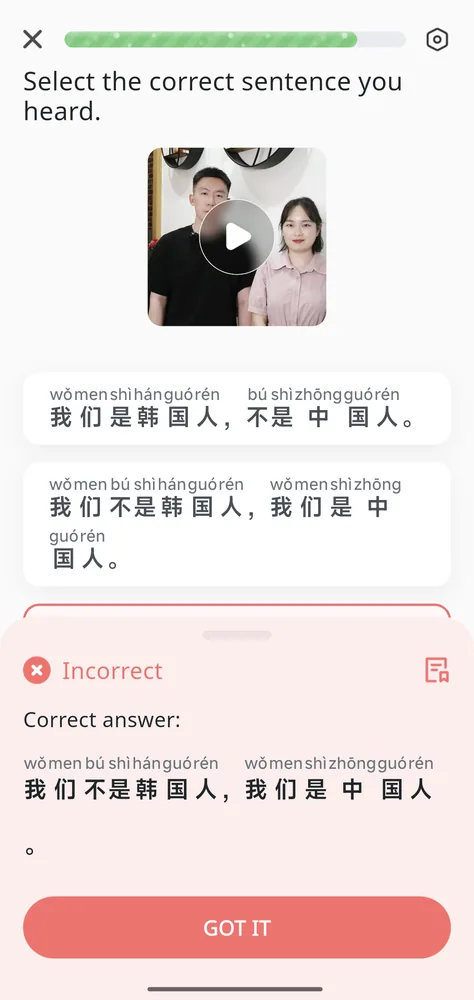
Inside the lessons, short exchanges keep the back-and-forth going. The quizzes in Level 1's first unit include one of these: one speaker's line, 再见,欢迎再来 ("Goodbye, come again"), is shown, the reply is blurred, and you say the other side out loud.
Scenario lessons with a task: a supermarket run
The fourth need, playing out a whole scene, is covered by SureChinese's Talk lessons. These are separate from the main course. In each one, a short brief sets out the scenario and three tasks, and the AI tutor takes the other role.
The supermarket lesson is a short example. You play a customer who wants to buy some goods and asks the sales assistant for help with choosing products and prices. The tasks are to state what and how much you want to buy, ask how much it is in total, and decline a bag or other add-ons.
In that lesson, the shopper's line 一共多少钱? ("How much altogether?") got the reply 一共二十块。需要袋子吗? ("Twenty yuan in total. Do you need a bag?"). The question about the bag is the cue for the third task, and the shopper's answer, 我不需要袋子,谢谢 ("I don't need a bag, thanks"), completed it.
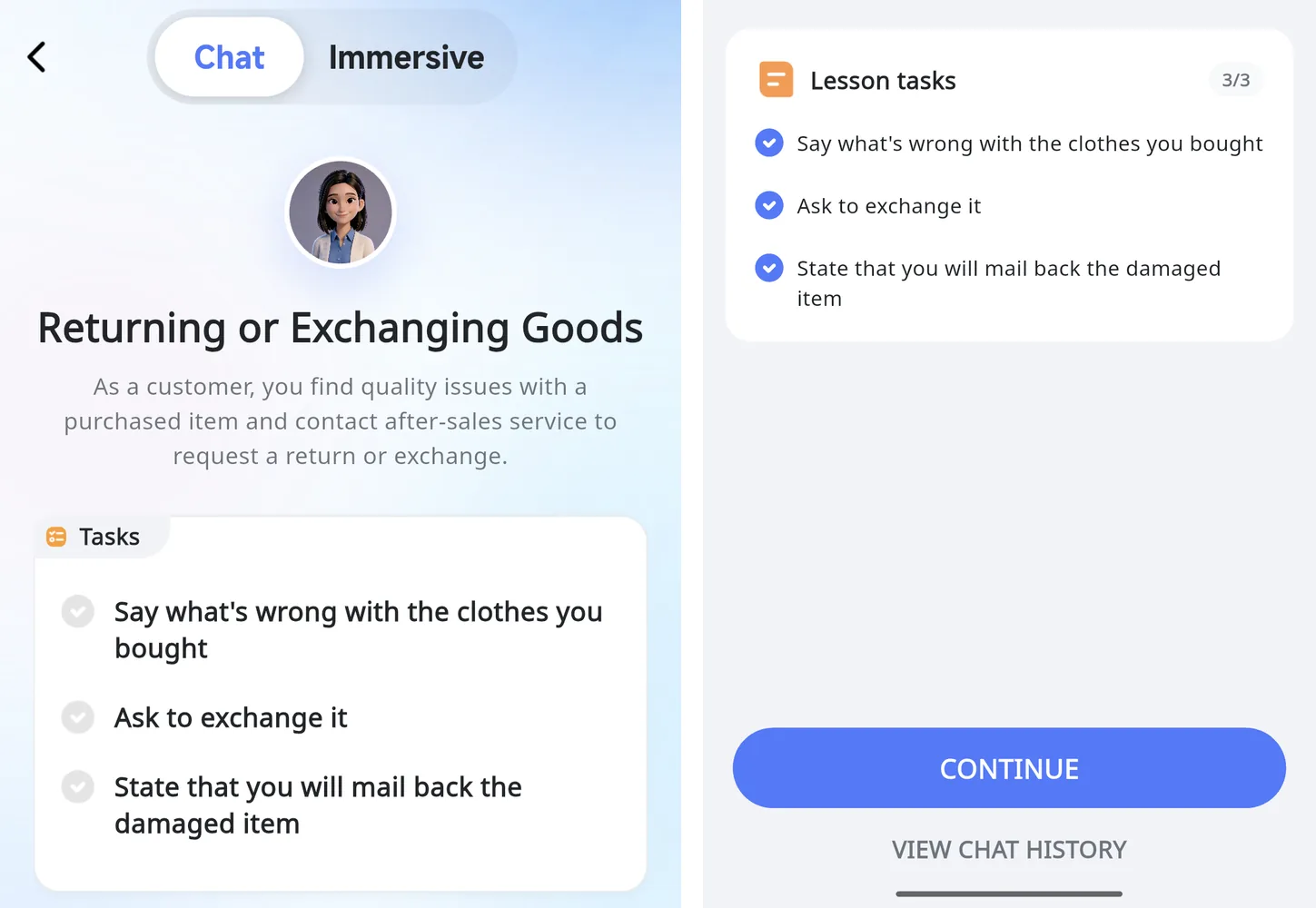
Short as it is, the scene trains what a phrasebook cannot. One reply carried both a price and a question, and the line that completed the third task answered the question, not the price: what came next depended on what the assistant had just said. When all three tasks were done, the lesson showed them ticked off, with the option to keep chatting or move on.
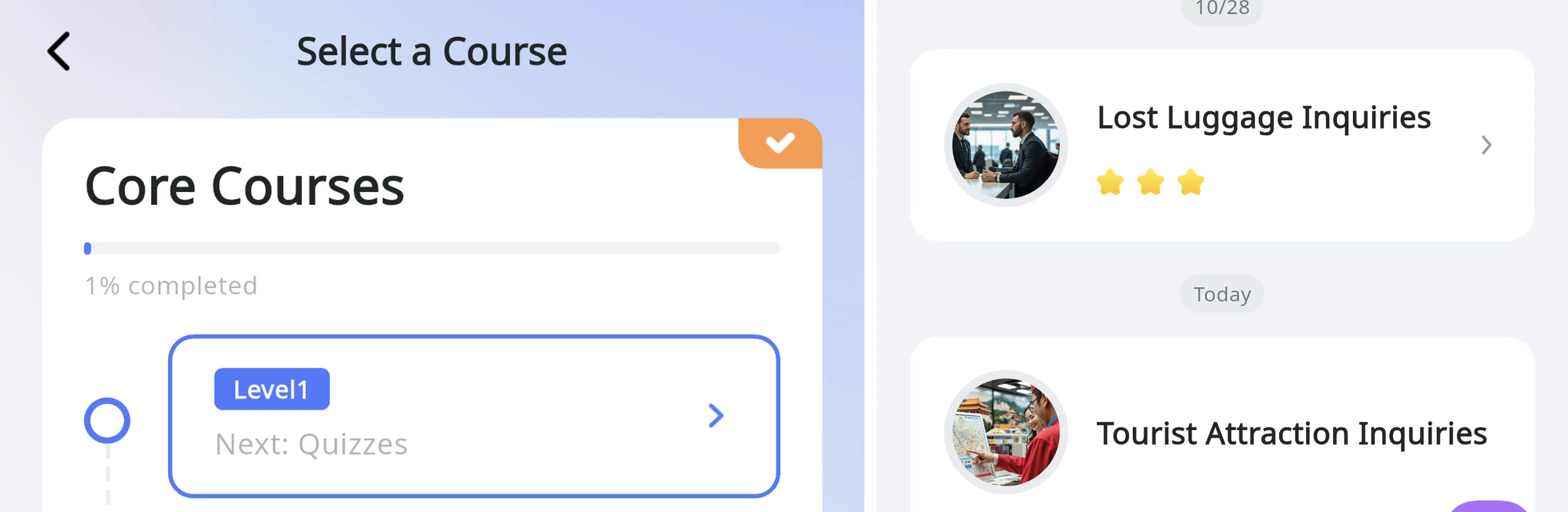
The Talk list reaches the workplace too: the set of lessons after the supermarket one includes a scene called First day at a job in China.
Who this suits, and where to begin
Some adults need Chinese for more than one purpose: a trip next spring, a semester abroad later, a job that involves Chinese-speaking clients. That mix is where SureChinese's course helps most, since the everyday units carry across all three and time spent on shopping or asking for help pays off whichever goal comes first.
A practical way to start:
- Work through the everyday core first. Shopping, directions and asking for help come up in every situation.
- Find your situation on the map. Look for the travel, campus or workplace units you will need and note which level they are in.
- Use the specialist phrases you already need. For work, a list of business Chinese phrases for meetings and email covers the most urgent lines in the meantime.
Whichever situation you study, practice the reply as much as the question. When someone speaks to you, repeat the key detail before you answer: the price, the time, the name. It shows you understood, it buys a second to think, and it trains your ear on exactly the information that matters.
At a shop counter, that might sound like this: the assistant says 一共二十块 ("twenty yuan in total"), and you answer 二十块?好的。 ("Twenty yuan? Okay.") before you pay. In an interview, the same habit works with a question: repeat the key words of what you were asked, then answer. Practiced daily, it makes catching the key detail a habit.
If two goals compete, plan by date. Study the everyday core whatever happens, then give the specialist units for the nearest deadline the most time: travel units before a trip in three months, campus units before a semester that starts next year. The other set can wait until you get there on the map.
Two more habits help across all three situations. Learn the everyday lines as whole sentences rather than single words, because that is how you will hear them. And when you study a specialist unit, note which everyday lines reappear inside it; those are the ones to make automatic first.
Get SureChinese, open the course map, and see which level holds the units for your trip, your degree or your job.