
What Is the Best App to Prepare for HSK 3 and HSK 4?
Preparing for HSK 3 or HSK 4 in 2026? First find out which format your test center runs. Then pick an app that makes you produce Chinese, not just recognize it. Here is how SureChinese fits.
Most people who ask me this have a vocabulary app already. They can recognize six hundred words on a flashcard and cannot write a sentence with any of them. That gap is what HSK 3 and HSK 4 punish, and it is the gap an app has to close.
So here is my answer in one line: the best HSK 3/4 app is the one that keeps up with the exam format your center actually runs, and then makes you produce the language rather than nod at it. In 2026 the first half of that sentence matters more than usual, because HSK 3.0 is still being trialed and has not replaced the old format everywhere.
I use SureChinese as the course-and-practice base, and I will show you why below. But do the format check first. It takes ten minutes and it decides which mock exams you should be buying.
Step Zero: Which HSK Are You Actually Sitting?
As of September 8, 2026, HSK 3.0 has not simply replaced every HSK 3 and HSK 4 session worldwide. Chinese Testing International (CTI), which runs the official HSK service at chinesetest.cn, has announced a second global HSK 3.0 trial for September 20, 2026. The notice says trial candidates at levels 3–6 must register at the same time for the corresponding oral test, and it lists both paper-based and internet-based options depending on the center. If your date is close to September 20, check registration deadlines with your center first; the trial may already be closed to new candidates.
That is one trial, not a worldwide switch. Before you buy a single mock, ask your test center four things:
- Is my session part of the HSK 3.0 trial or a regular sitting?
- Paper or computer?
- Do I have to register for an oral test as well?
- Which sample paper matches my date?
The app organizes your learning. CTI and your center define the exam.
What the Official Pages Say About HSK 3 and HSK 4
The current HSK Level 3 page describes HSK 3 as serving elementary learners with general listening, reading, and writing ability, and lists 80 questions across those three sections. The HSK Level 4 page describes HSK 4 as serving intermediate learners and lists 100 questions across the same three sections. Both give section scores and a total.
Two practical points fall out of that. First, writing is a section, not an afterthought, at both levels. Second, the difference between 3 and 4 is not a word count you can memorize your way across. It is whether you can hear, read, and produce longer chunks under time. Pick your level by trying a matching sample paper, not by counting flashcards.
What an HSK 3/4 App Has to Do
I judge them on five things:
- Say which levels it covers, and not pretend to be the exam. Alignment is a course design choice. The test authority is CTI.
- Work all the skills. Listening, reading, writing, and speaking. Vocabulary recognition alone will not cut it at HSK 3.
- Bring your misses back. If a wrong answer disappears when the lesson ends, you will make it again in the exam hall.
- Make you produce. Build a sentence. Write a character. Say the line to somebody who answers.
- Know the difference between learning and simulation. A course teaches. A timed mock in the right format tests. You need both, and you need to know which one you are doing.
How SureChinese Handles Those Five
SureChinese's courses, backed by New Oriental Education, run from HSK 1 through HSK 4 and work listening, speaking, reading, and writing inside every lesson. It runs on iOS and Android. I tested it on a free account, so the screens below come from Level 1. They show you the task types; the content gets harder as the levels climb.
The structure is on one page
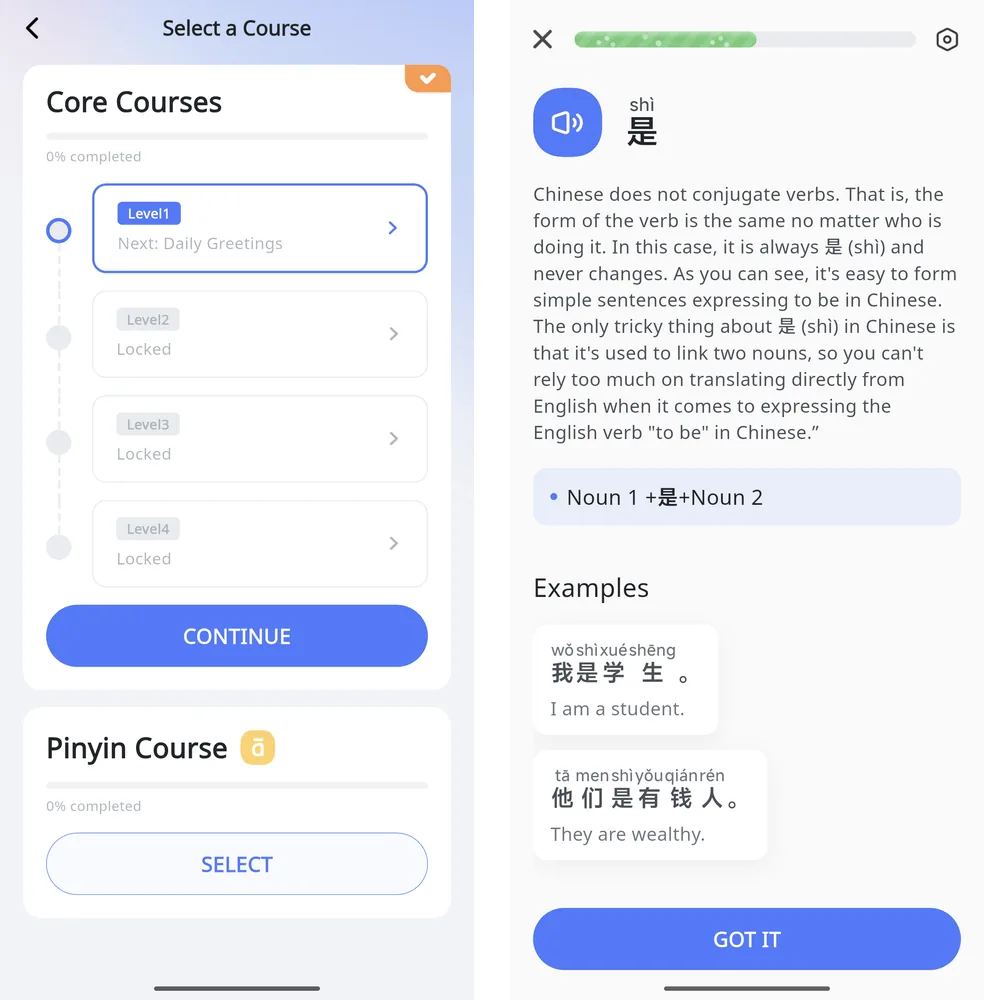
The course-selection screen lays the four levels out in order, with the later levels shown as locked until you reach them. Inside a lesson, grammar arrives as a card: the point, a pattern you can reuse, example sentences with pinyin and English. The first one I hit was 是 (shì) with the pattern Noun 1 + 是 + Noun 2. Nothing is left as a rule floating in the air.
Listening comes with a grammar check built in
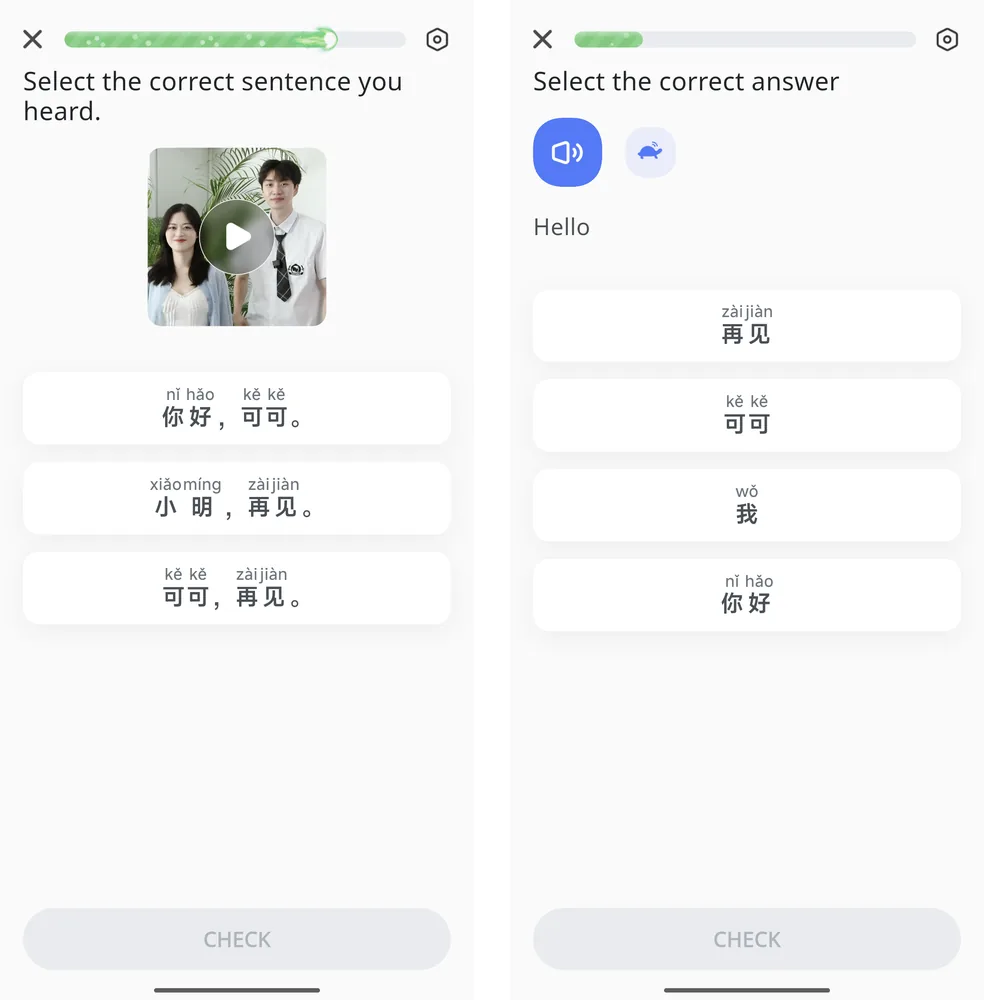
Two kinds of listening turn up in the very first lesson. Video questions play a short clip of a real teacher and ask you to pick the sentence you heard, and the options differ by exactly the grammar the lesson is teaching: 你好,王小明。 against 你好,我是王小明。 Audio questions play a recording with a slow-speed button beside it, so you can hear the syllables pulled apart before you answer at full speed. HSK listening sections do not slow down for you. Practicing at both speeds is how you get ready for that.
Writing at two levels, in the same lesson
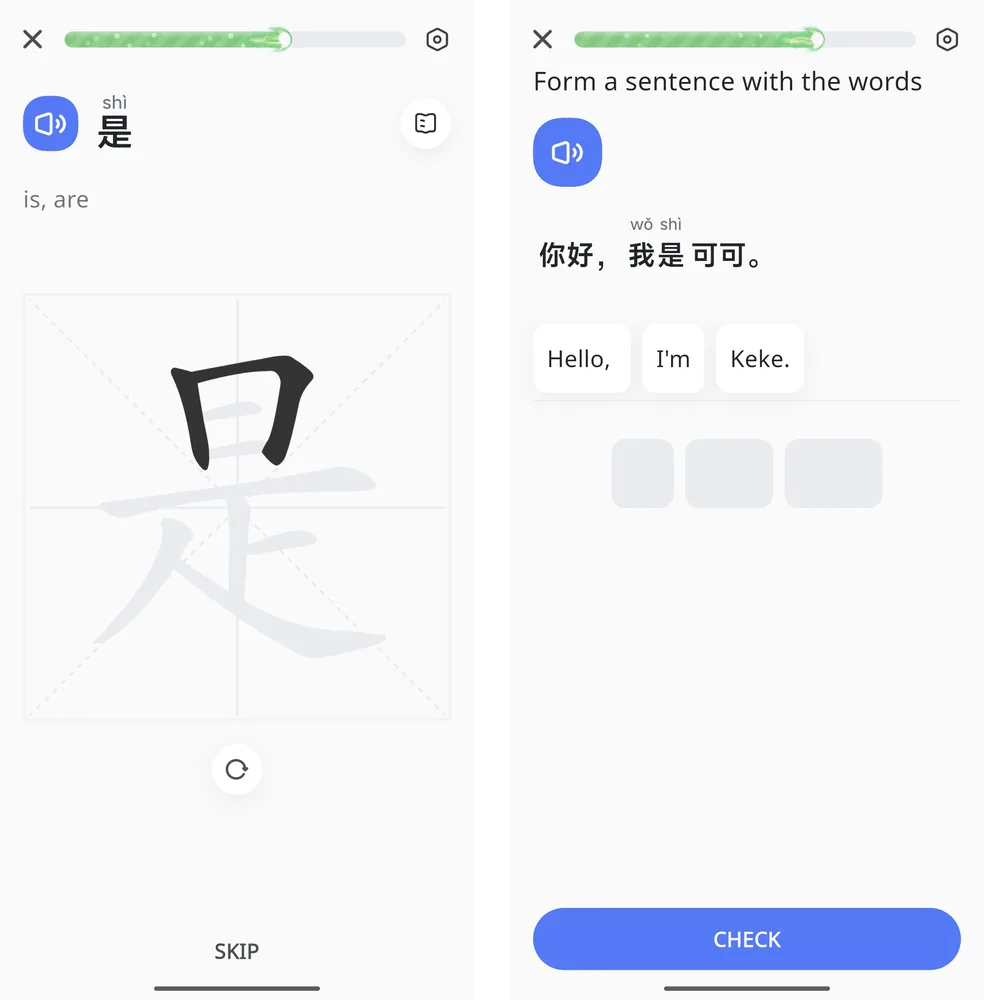
Character tracing puts each new character into a grid and has you write it stroke by stroke, right after a card has explained what its parts mean. Sentence-building gives you a Chinese sentence and a bank of word tiles to put in order. The first builds the shape of the character. The second builds word order, which is where most HSK 3/4 writing marks go missing: you know every word in the sentence and still put them in the wrong place.
Your misses stay in reach
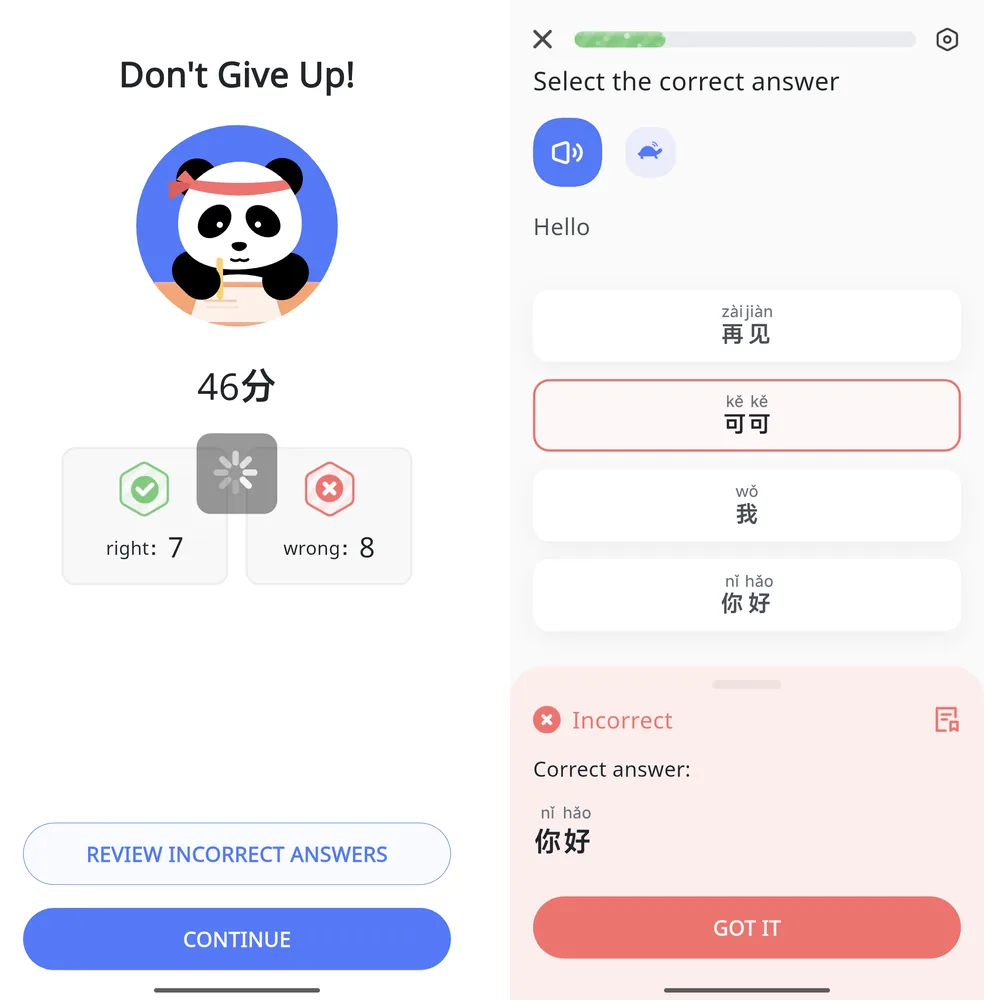
Every wrong answer gets a red "Incorrect" panel that shows the correct answer before you move on. Every lesson ends on a results page that separates right from wrong and offers a "REVIEW INCORRECT ANSWERS" button. Mine said right 7, wrong 8; I was testing the wrong-answer screens on purpose, but the app did not know that. Those scores are the app's own practice scoring, not an HSK score. The Profile page also keeps a My Mistakes Book and My Bookmarks for anything you choose to save.
It makes you produce, and then tells you what to fix
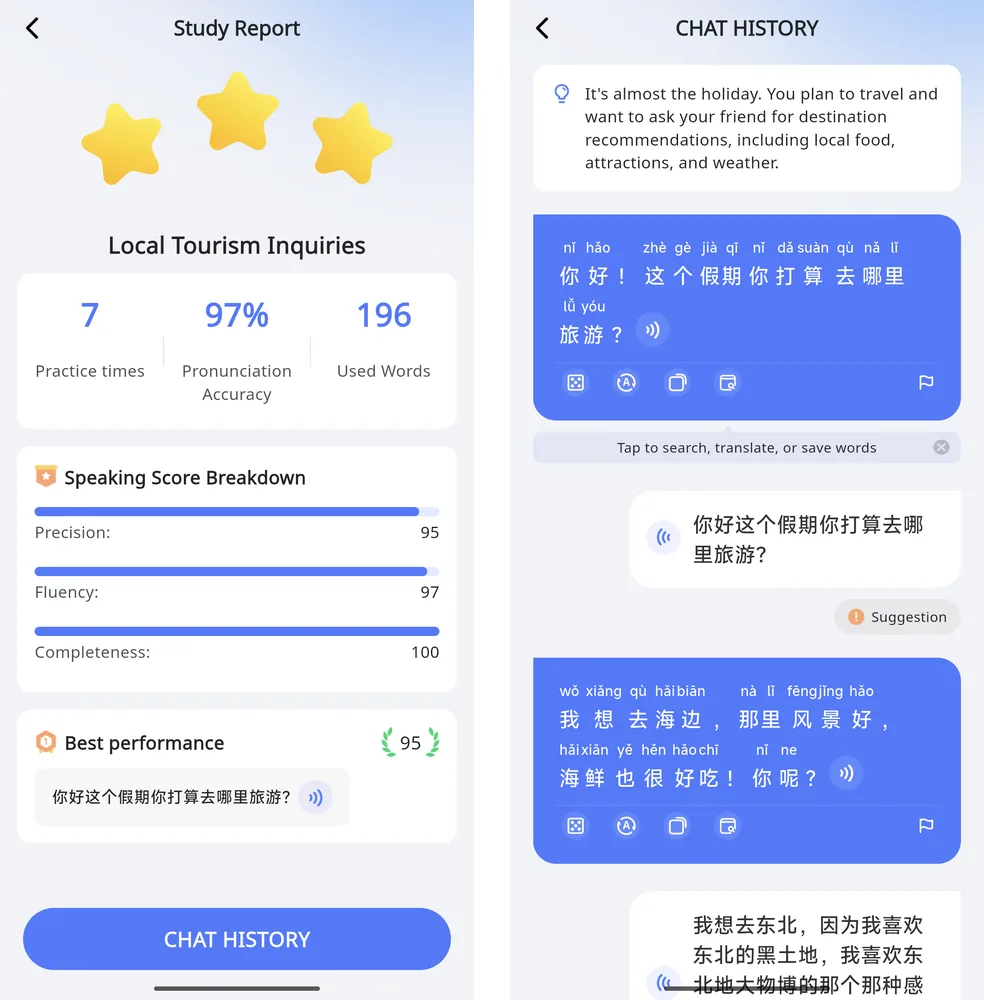
This is the part vocabulary apps cannot do. In the Talk tab, each lesson is a real-life scenario with a task; mine was asking a friend for travel tips before a holiday. The AI partner speaks first, pinyin above every character, and you answer by voice or by typing. New Oriental's own launch article describes it as progressive design, scenario-based conversation, free expression, and feedback. In practice it feels like a patient language partner who never gets bored.
Every reply gets a tag: green "Grammar" when it works, orange "Suggestion" when there is a better way to say it. Tap the tag and a panel opens with Grammar and Pronunciation tabs. The Grammar tab showed my sentence, a cleaner rewrite with a PRACTICE button, and an explanation in English. Mine pointed to a missing question mark that was blurring two thoughts into one. An HSK writing marker would have docked me for that. My flashcard app would never have noticed.
Exam prep slides into pure recognition if you let it: reread the word, check the answer, pick from four options. A conversation puts you on the spot. You have to take in what was just said, pull up the right words, and answer before the moment passes. That does not replace timed writing practice, but it finds gaps that passive review hides, and it finds them fast.
When you have said enough, an "End Course" button appears and you get a Study Report: stars, Practice times, Pronunciation Accuracy, Used Words, a Speaking Score Breakdown into Precision, Fluency, and Completeness, and your best sentence of the session. A Chat History button keeps the whole conversation, tags included.
SureChinese frames the speaking side as the Spiral Speak Method: Echo, Choice, Mini-Dialogue, Free Talk, from repeating a model to answering in your own words. Use the Free Talk end to find gaps, not to predict a score. SureChinese is HSK-aligned and structured through HSK 4. CTI and your center remain the only sources for exam and registration rules.
You can start for free. The free plan covers the first unit of the main course and one Talk scenario a day, with an energy budget for AI replies that refills when you check in. The full HSK 1–4 path, unlimited conversation, and the AI feedback features are unlocked by subscription; offers vary by market.
The Plan I Would Actually Follow
1. Diagnose with the right sample paper
Get a sample or mock in the format your center confirmed. Sit it. Then log every miss by task, not by feeling: listening, reading, sentence order, character production, running out of time, oral response if your session has one. "Bad at vocabulary" is not a diagnosis. "Lost four marks on 把 sentences" is.
2. Rebuild the weak units in the course
Take each diagnosed weakness back to the lesson that teaches it and work it in full sentences. A grammar point tied to a lesson and an example is a thing you can fix. A grammar point floating in a list is not.
3. Produce it, get corrected, come back in three days
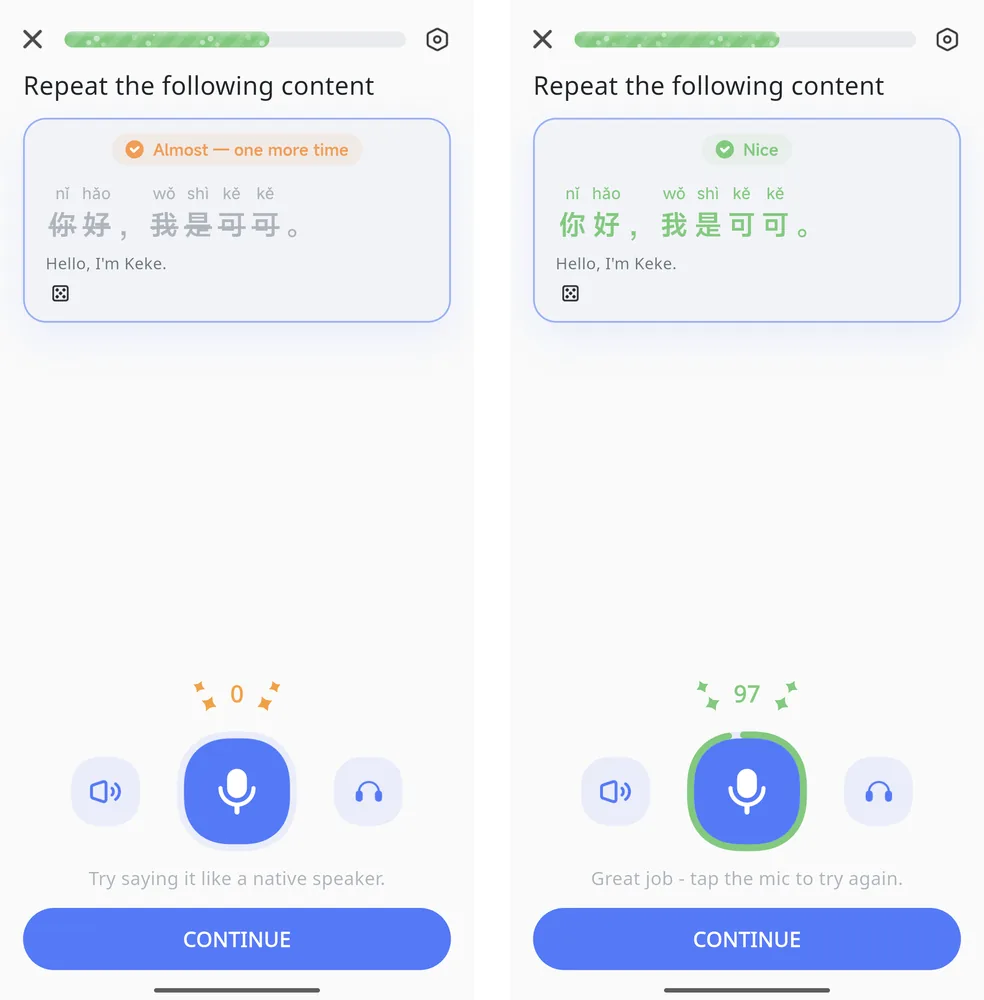
Close the lesson and recall the language cold. Write a sentence. Say it into a Talk scenario. When the feedback flags something, take another shot right there, then circle back a few days later. The read-aloud tasks are built for this. A low score shows "Almost — one more time" and leaves the microphone where it is; a good one turns the sentence green.
Talk makes this stage easy to keep up. Scenarios sit in a plan of ten lessons, one opens each day, and each finished one carries a star rating. For listening under pressure, one tap blurs the partner's Chinese so you have to rely on your ears, and the audio speed goes up to 1.75x, which is faster than any HSK recording you will meet.
4. Go back to timed, format-matched practice
Now do exam-format tasks under the timing and rules of your session. Review the wrong answers and the slow right ones. In the version I tested, SureChinese had no timed HSK mock, and it does not pretend to; get that from exam-format materials that match your sitting. The week before, confirm date, venue, format, ID requirements, and any oral-test registration with the center directly.
How many weeks? Depends where you start, which format you sit, how often you study, and what score you need. Anyone who gives you a number without asking those four things is guessing.
What to Keep Alongside It
- The latest CTI notices and your center's instructions, for format and registration.
- Exam-format mocks, for timing.
- A teacher, when a writing or speaking problem needs a human diagnosis.
- Any accommodations you need, arranged through the testing channel, not the app.
SureChinese builds and drills the language. CTI and your center define the exam. Keep those two jobs separate and you will not waste a week on the wrong mock.
Frequently Asked Questions
Can SureChinese be my only HSK 3 or HSK 4 resource?
Make it your main course-and-practice app, then add the current format information from CTI and exam-format mocks. Bring in a teacher when you need detailed correction or someone to keep you honest.
Does HSK 3 or HSK 4 include speaking?
The current HSK 3 and HSK 4 pages list listening, reading, and writing. But for the second HSK 3.0 global trial announced for September 20, 2026, candidates at levels 3–6 must register at the same time for the corresponding oral test. Confirm your own session with your center.
What is changing with HSK 3.0?
As of September 8, 2026, CTI has announced a second global trial with its own registration and format details. That does not mean every center has switched. Use the CTI notice and your center's instructions for your date.
Should I choose HSK 3 or HSK 4?
Sit a matching sample paper for each and see which one you can finish in time with marks to spare. Choose on that, not on a vocabulary count.
Does HSK-aligned mean the app is part of the testing authority?
No. It means the course is organized around HSK levels. The app is not a test authority and does not set registration rules.
The Bottom Line
For HSK 3 and HSK 4, the app that helps most is the one that turns words you recognize into words you can produce, and then tells you what to fix. SureChinese does that inside each lesson, with grammar cards, teacher-video listening, character tracing, and sentence ordering all pulling on the same material, and then again in Talk, where you have to say it to someone who answers back. Your misses stay one tap away. Confirm the format with your center, diagnose with a matching paper, rebuild the weak units, produce the language, and go back to the clock.
Learn Chinese. Actually speak it.
Build your HSK foundation, then practice using it in real conversations. Start for free on iOS or Android.