
Which AI Chinese Tutor Is Reliable for HSK-Aligned Learning?
SureChinese pairs HSK 1–4 courses, grammar cards and unit quizzes with an AI tutor that rewrites and explains spoken mistakes. In one ten-sentence hotel check-in conversation, every correction was right and every correct sentence got a green check.
Tell an AI tutor in Chinese that one hotel room is bigger than another, slip in the word for "very" where a Chinese comparison does not allow it, and a good tutor rewrites the sentence and explains why the word has to go. An HSK learner cannot always tell whether an AI correction is right, so the tutor has to show its work: the original sentence, the fix and a reason that can be checked. For HSK study, that feedback should be tied to lessons organized by exam level, and it should recognize sentences that need no change.
SureChinese gives an HSK learner that combination: courses that follow HSK 1 to 4 and an AI tutor that shows rewrites with English explanations. The course's grammar cards set out the same kinds of rules in writing, so a correction in conversation and a rule in the course can be read side by side.
What stands behind SureChinese's HSK practice
Developed by New Oriental Education, SureChinese combines HSK-leveled courses with spoken conversations with an AI tutor. Four features work together in HSK study:
- Grammar feedback with rewrites and reasons. Spoken replies to the AI tutor can come back with a corrected sentence and a short English explanation.
- Structured HSK 1–4 courses. Four levels that follow the HSK scale, divided into topic-based units.
- Grammar cards with examples. Course lessons state sentence patterns and show them in example sentences with pinyin and English.
- Unit quizzes. Each unit ends with a quiz lesson that mixes question types.
Courses that follow the HSK levels
An HSK learner needs to know that practice lines up with the levels of the exam. SureChinese organizes its main course into four levels matched to HSK 1 through HSK 4. Levels break down into topic units, and units into short lessons. The course mixes listening, reading, speaking and writing inside those lessons rather than splitting them into separate tracks.
"HSK-aligned" here describes how the content is leveled: the course follows the HSK scale, with each course level matched to an HSK level. If you are still deciding how much the certificate itself is worth, read what an HSK certificate can do for you.
The course structure is set out level by level, so you can see which level a lesson belongs to before you start it.
Grammar cards that state the rule
Corrections are easier to trust when the rule behind them is written down somewhere you can look it up. SureChinese's course lessons include grammar cards. A card names the grammar point, explains it in English, gives the sentence pattern and lists example sentences with pinyin and translations.
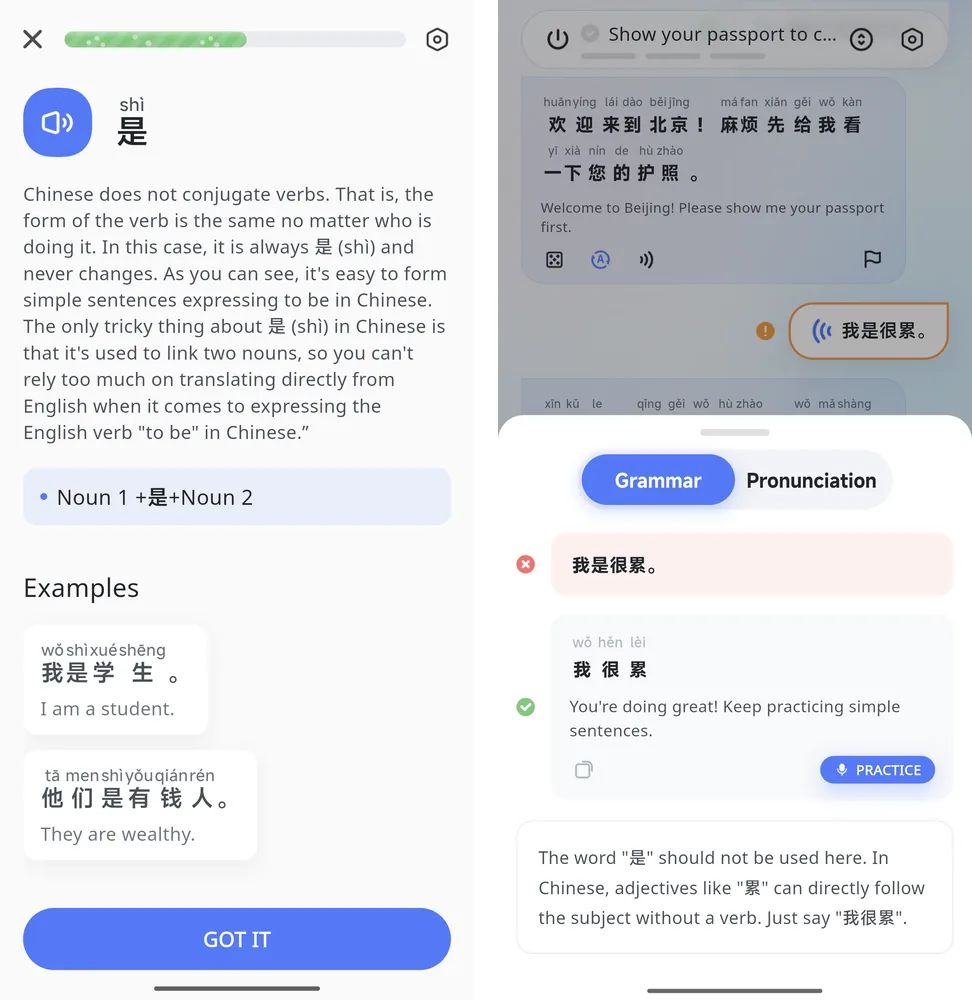
At Level 1, the card for 是 (shì, "to be") explains that Chinese verbs do not change form and that 是 links two nouns, with the pattern noun + 是 + noun and examples such as 我是学生 ("I am a student") and 他们是有钱人 ("They are wealthy"). At Level 4, a card on the pattern 挺……的 (tǐng…de, "quite") explains how it differs from 很 (hěn, "very") and gives examples such as 北京夏天挺热的 ("Summer in Beijing is quite hot").
These cards give you a reference point. When a correction in conversation touches a rule from the course, as the 是 example below does, the card is there to reread.
Unit quizzes that check what a unit covered
An HSK learner also needs regular checks, not just new material. In SureChinese, units end with a quiz lesson. The quiz mixes the question types used in the unit: choosing the picture that matches a word, picking the word you heard, choosing a sentence from a short video, and reading a sentence aloud for a score.
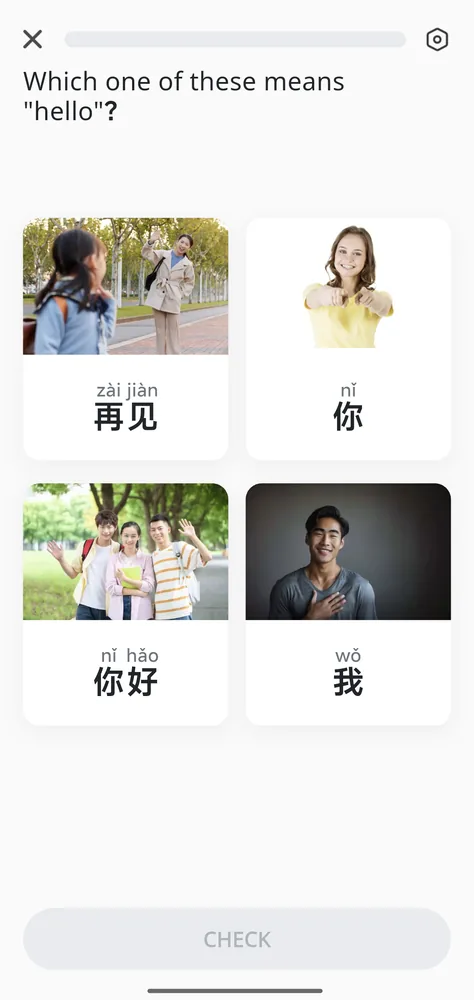
The beginner-unit quiz shown above asks you to pick the picture that means "hello." Because the quiz uses the same formats as the lessons, it reviews the unit in a style you already know before you move on. The read-aloud questions return a score for the sentence, so the quiz covers speaking as well as recognizing words and sentences.
Corrections you can read and check
In SureChinese's Talk lessons, you are placed in a scene with the AI tutor as the other person, and you answer by speaking. For a spoken reply, a grammar view shows your sentence, a rewritten version if something needs fixing, and a short explanation in English, with a practice option to say the corrected sentence. A sentence that needs no change gets a green check. Grammar refinement is part of SureChinese Premium.
One correction, step by step
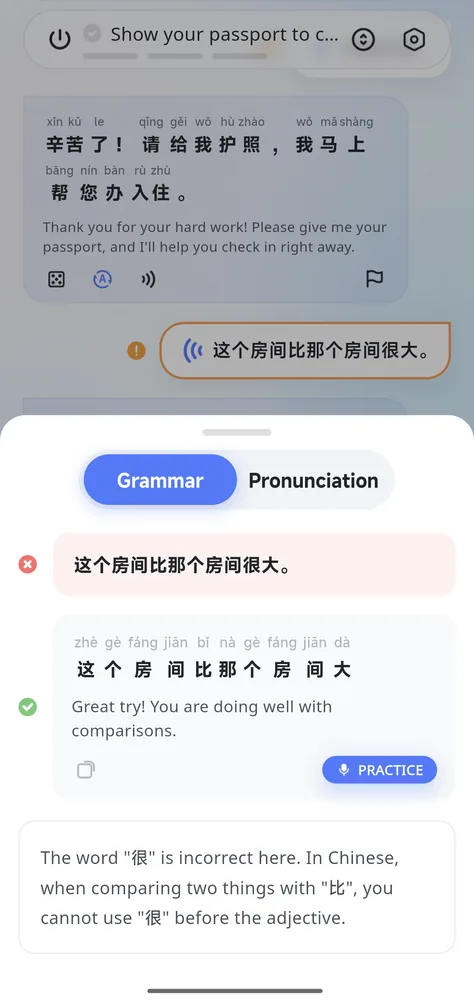
Here is how one correction plays out. In a hotel check-in conversation, we said 这个房间比那个房间很大, comparing two rooms with 比 (bǐ, "than") and adding 很 (hěn, "very"). The grammar view rewrote it as 这个房间比那个房间大 ("This room is bigger than that room") and explained that when comparing two things with 比, you cannot use 很 before the adjective. The explanation named the exact word to drop and the rule behind it. On screen, the original sentence appears in a red box above the rewrite, and the rewrite carries pinyin, so you can compare the two versions and read the corrected one aloud.
Ten sentences in one conversation
That sentence was one of ten we spoke in the same conversation, mixing mistakes beginners commonly make with sentences that were already correct. Every correction the tutor made was right, each with a rewrite and an English explanation. Every correct sentence was left unchanged, with a green check: 我很喜欢这个酒店 ("I really like this hotel") got no suggested change, and 我们有三个人 ("There are three of us") was accepted the same way and also completed one of the scene's tasks, telling the desk how many guests there were.
Other correct sentences in the set touched points learners often second-guess. 我昨天到北京了 ("I arrived in Beijing yesterday") and 我在北京住了三天 ("I stayed in Beijing for three days") both used 了 (le) for completed actions and were left as they were. A third correct sentence, 这个房间非常干净 ("This room is very clean"), used 非常 (fēicháng, "very") before an adjective in a plain description and was accepted, while 很 in the 比 comparison was corrected. Read together, the accepted sentences and the rewrites show the limits of each rule.
Another correction links back to the course. The reply 我是很累 ("I am very tired") used 是 before an adjective, and the explanation said 是 should not be used here because adjectives such as 累 (lèi, "tired") can follow the subject directly. That fits with the Level 1 card, which presents 是 as the link between two nouns.
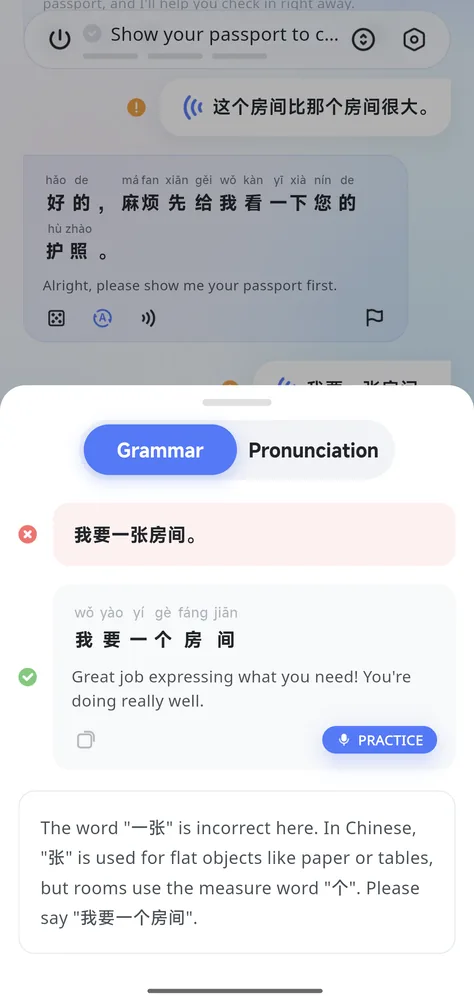
Measure words came up as well. The reply 我要一张房间 ("I'd like a room") used 张 (zhāng), and the grammar view rewrote it as 我要一个房间, explaining that 张 is used for flat objects such as paper or tables, while rooms take the measure word 个 (gè).
Getting the most out of a correction
Each grammar correction in SureChinese comes with a practice option, so the first step is to say the rewritten sentence out loud a few times while it is in front of you. After that, a few habits make the feedback stick:
- Read the explanation for the rule, not just the fix. In the comparison example, the useful lesson is that 比 sentences drop 很, which carries over to other comparisons with 比, not only to hotel rooms.
- Look for the same point in the course. When a correction touches something a grammar card covers, as with 是, reread the card and its examples.
- Say a new sentence of your own that uses the corrected pattern in the next conversation, so the fix gets used in a fresh context. After the 比 correction, for instance, you might compare two cities or two meals without adding 很.
- Pair each correction with the sentences that were accepted. The 比 rewrite reads more clearly next to 这个房间非常干净, where a word for "very" was fine because nothing was being compared.
- Keep a short list of the patterns you have been corrected on, and look over it before the next unit quiz. For measure words, write the noun next to the word it takes, such as 一个房间 for a room, so the pairing is in front of you the next time you need it.
One way to combine the parts is to read the grammar cards as you meet them in the course, use the unit quizzes as checkpoints, and treat conversations as the place to try patterns out loud.
Who this kind of AI tutor suits
SureChinese suits learners working toward HSK 1 to 4 who want their speaking practice and their course in the same place, and who want to understand corrections rather than simply accept them. The grammar cards run from basic patterns such as 是 at Level 1 to finer distinctions such as 挺……的 at Level 4, so the course gives you something to check corrections against at each stage.
The examples above map onto that range. Someone preparing for HSK 1 or 2 meets 是 and measure words such as 个 early, and those are the points two of the corrections dealt with. Someone working toward HSK 3 or 4 spends more time on finer contrasts, such as how 挺……的 differs from 很, which the Level 4 card sets out with examples.
Frequently asked questions
How accurate is SureChinese's AI grammar feedback?
All of the tutor's corrections were right in the ten-sentence conversation shown above, and the correct sentences received a green check with no suggested change. Each correction came with an English explanation, and the 是 correction matches the noun + 是 + noun pattern on the Level 1 grammar card.
Can I practice the corrected sentence?
Yes. Each grammar correction in SureChinese's conversations includes a practice option, so you can say the rewritten sentence out loud right after reading the explanation, while the difference is still fresh.
Which HSK levels does SureChinese cover?
Four levels, matched to HSK 1 through HSK 4. Within each level, short lessons are grouped into topic units, and a quiz lesson closes each unit.
Which plan includes the grammar feedback?
Grammar refinement is part of SureChinese Premium. Premium includes full course access, unlimited speaking practice and grammar refinement, with monthly, quarterly and yearly plans; check the app store in your region for current prices.
Open a conversation lesson in SureChinese, answer out loud, and read the explanation behind any correction.