
What App Helps With HSK Vocabulary, Grammar, Listening, and Mock Test Preparation?
SureChinese's HSK-leveled lessons train vocabulary, grammar and listening in the same lesson, and each unit ends with a Quizzes checkpoint. Add timed official sample papers in the final weeks.
HSK preparation splits into two kinds of practice, and they do different jobs. For most of your study time, you work on vocabulary, grammar and listening side by side, a lesson at a time, so that weak spots show up early and get fixed. In the last few weeks before the exam, you add timed, full-length sample papers to get used to the pace of the test and to how you spend the time. An app earns its place in the first phase; the second phase belongs to the papers.
SureChinese covers the first phase, the day-to-day skill work: in Level 4 lessons such as Weather and Climate, new words, a grammar card and listening questions appear in the same lesson. Each unit then ends with a Quizzes lesson, a checkpoint before you move on to full sample papers.
Two kinds of HSK practice, and when each one matters
Skill practice and full mock tests answer different questions. Skill practice asks: which words, patterns and sounds do I still not have? A full mock test asks: can I do all of it under exam conditions, in the time allowed? Both matter, but at different moments.
The HSK reports a separate score for each section (listening, reading and, from HSK 3, writing), so a weak section stands out on the result. That is useful only if you still have time to work on it, which is why daily skill practice comes first and fills most of your calendar. Full papers come later, when the goal shifts from learning to performing. The format is moving between exam versions, so check the official description for the version you register for before planning around question counts or timing.
Most problems learners describe are skill problems. A word is familiar on paper but slips past in the audio. The later listening questions are long and hard to follow. A grammar rule is clear in the book, yet the word lands in the wrong place, and only targeted practice fixes that; a full paper can only show that the problem exists.
In the daily phase, useful practice:
- Shows each new word from several directions: a picture, its sound and a sentence.
- Teaches grammar with examples, then asks you to use it: placing the word in a sentence yourself.
- Trains listening at normal speed, with a way to slow down, using both audio-only and video questions.
- Checks each stage with a short self-test and lets you look again at what you missed.
- Leaves room for full papers in the final weeks.
How much vocabulary each level expects is covered in our guide to how many words each HSK level needs.
Where SureChinese fits: HSK-leveled lessons that train three skills at once
Developed by New Oriental Education, SureChinese teaches Chinese through two connected parts: structured HSK courses and AI speaking practice. Its bite-sized lessons are leveled around HSK and strengthen listening, speaking, reading and writing. The course has four levels lined up with HSK levels 1–4, so an HSK 4 candidate works in Level 4.
An HSK candidate can put the following to work:
- Lessons that combine three skills. A Level 4 lesson like Weather and Climate runs to around fifteen questions. It moves between new words, a grammar point and listening, so all three get practice in one session.
- Vocabulary from several directions. New words appear with pictures, in audio and inside sentences.
- Grammar cards followed by sentence work. The cards explain a pattern with examples, and later questions ask you to place the word or build the sentence.
- Listening with a slow option. Some audio-only questions come with a slow-play control, and the lesson settings offer audio speeds from 0.5x to 1.5x.
- Unit Quizzes. A checkpoint at the end of each unit, with a way to review only the questions you got wrong.
The three skills in one sitting also share their vocabulary. Take one Level 4 lesson on weather and climate. In that lesson, 风景 (fēngjǐng, "scenery") appears as a new word. It also turns up in the options of a listening question, in a picture question and in a sentence you translate by arranging word blocks.
Vocabulary that shows up in pictures, sound and sentences
A word list shows a word in one form only: characters next to a translation. In the exam, the same word reaches you through audio, inside a sentence, or as one option among several. Meeting it in more than one form while you learn it prepares you for all of them. A plain word list gets closer to that once you say each word aloud, listen to it once and write one short sentence with it.
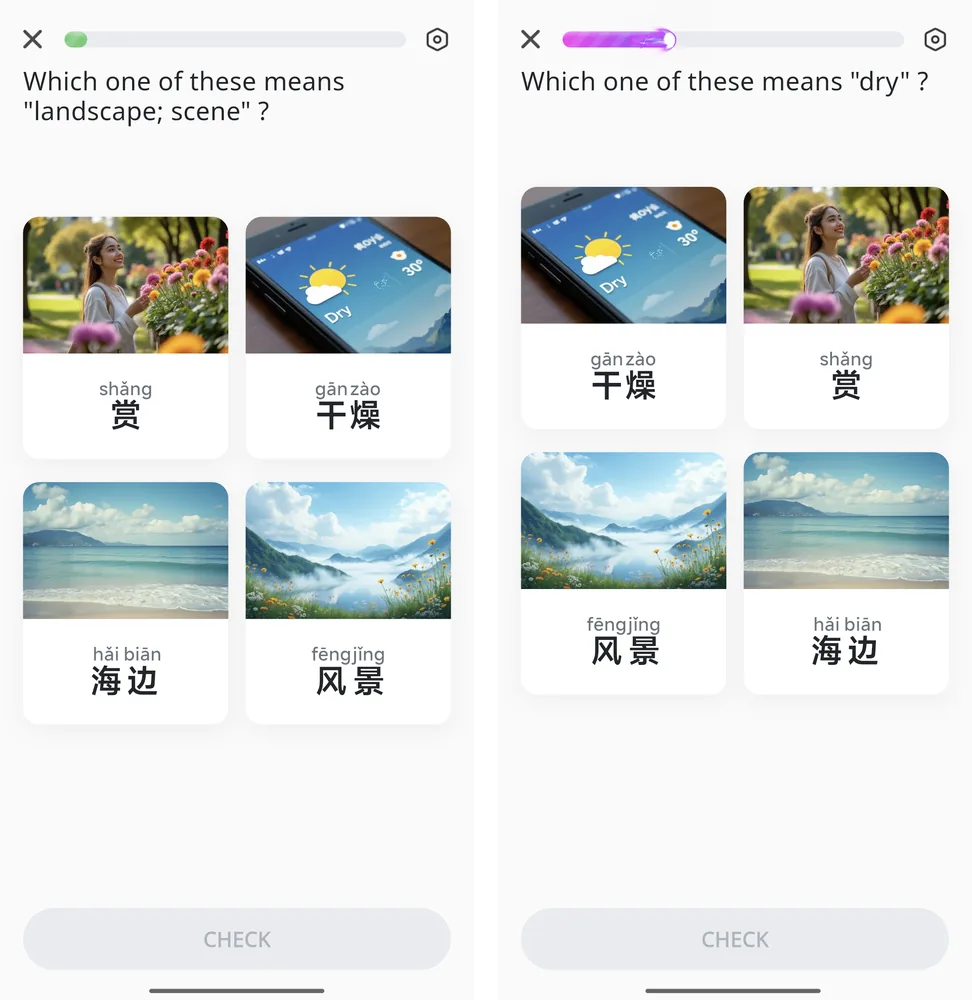
In the Weather and Climate lesson, new words come in through picture questions. One asks which card means "landscape; scene", with 赏 (shǎng, "enjoy the beauty of"), 干燥 (gānzào, "dry"), 海边 (hǎibiān, "seaside") and 风景 (fēngjǐng, "scenery") as options. Another asks for "dry" from the same four. At the end of the lesson, a matching question pairs the same words with their pictures.
A character card in the same lesson breaks down 景 (jǐng, "scenery"): 日 (the sun) points to the meaning and 京 (jīng) gives the sound. Knowing how a character is put together can help you tell it apart from similar-looking ones in the reading section.
Grammar cards, then the pattern goes into a sentence
HSK grammar questions often test where a word goes, not just what it means. Knowing a rule and placing the word correctly are two different steps, and mistakes tend to happen at the second.
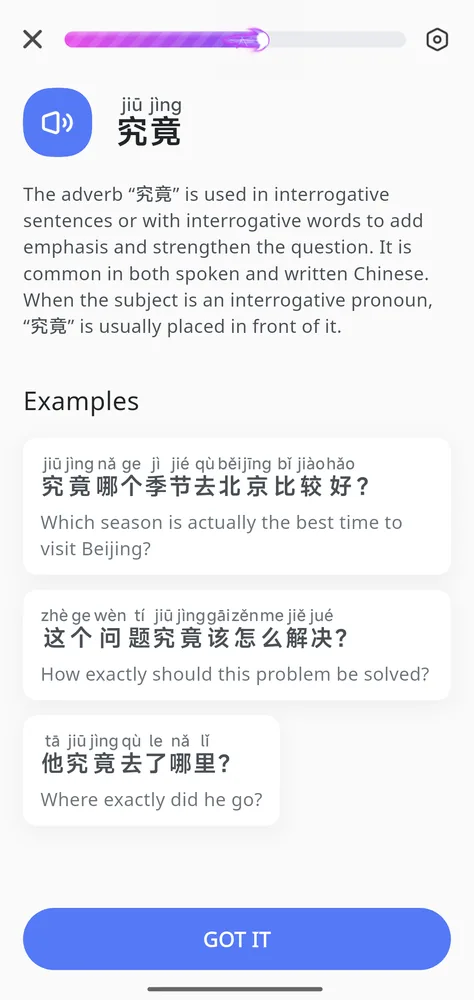
In the SureChinese lesson that follows Weather and Climate, a grammar card introduces 究竟 (jiūjìng, roughly "actually" or "exactly" in a question). The card explains that it adds emphasis to a question, and that when the subject is a question word, 究竟 usually comes before it. It gives three examples with pinyin and English, such as 究竟哪个季节去北京比较好? ("Which season is actually the best time to visit Beijing?").
A later question in that lesson asks for 秋天在北京,究竟该穿什么? ("What should you wear in Beijing in autumn?") built from word blocks, so the rule has to become a sentence. Another asks you to drop 究竟 into the right gap of a sentence about November weather in Beijing.
Weather and Climate puts 挺……的 (tǐng…de, "quite") to work in the same way. One question asks you to put 挺 into 北京夏天_热的 ("Beijing summers are _ hot"), and in another you build the English for 那里的风景挺美的, "The scenery there is quite beautiful," from word blocks. A grammar book can be used in the same order: read the explanation, close the book, write two sentences of your own with the pattern, then check the word order against the examples.
Listening at full speed, with a way to slow it down
In the exam, listening recordings run at normal speed and cannot be paused. At HSK 1 to 3 each item is played twice; from HSK 4, you hear it only once. Either way, listening needs practice of its own. Practice should include normal-speed audio, a way to slow it down when a word slips past, and more than one kind of recording.
One audio-only question in SureChinese's Weather and Climate lesson offers 赏月 (shǎngyuè, "admire the moon"), 赏花 (shǎnghuā, "admire flowers") and 赏景 (shǎngjǐng, "enjoy the view"). The question asks for the one you hear, with a slow-play control next to the audio. A video question shows a speaker filmed outdoors and asks which of several sentences about Beijing's scenery in different seasons you hear. Another audio-only question offers three versions of a sentence about Beijing's four seasons, differing only in the last word.
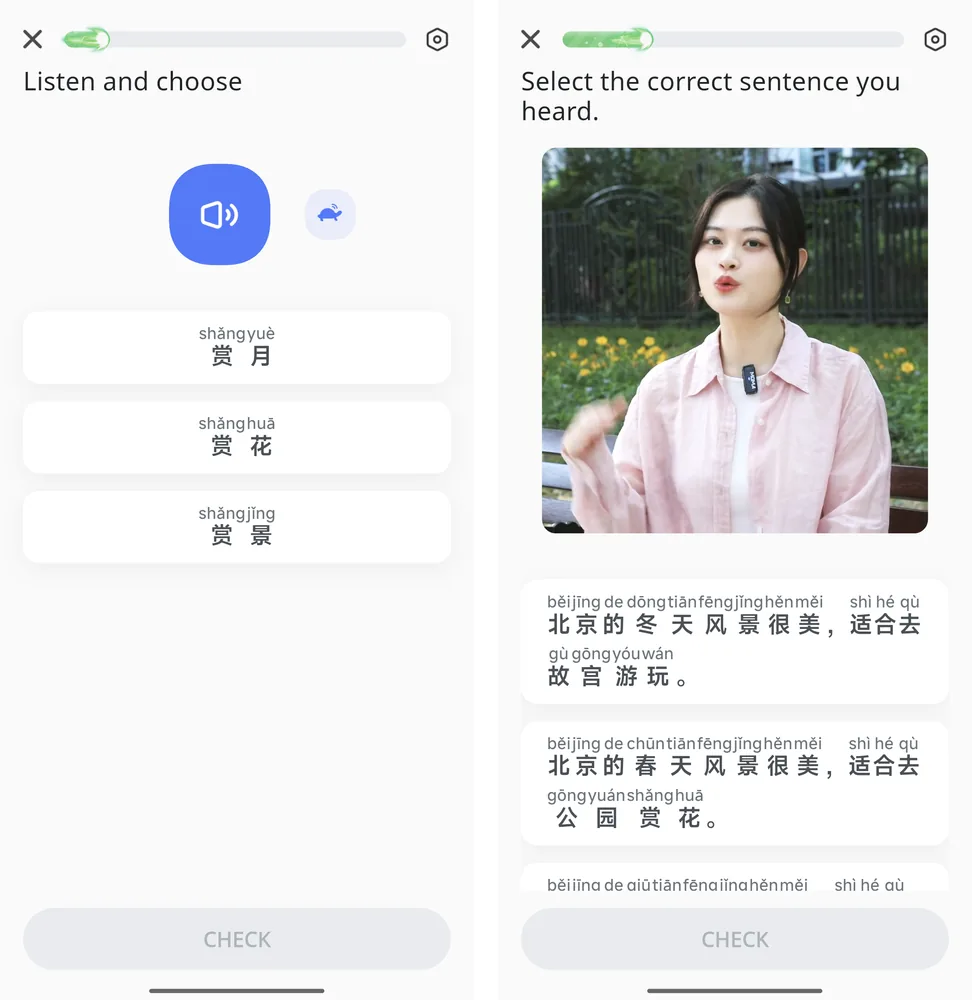
Options that differ by a single word or syllable, like 赏月, 赏花 and 赏景, train the exact skill the exam checks: catching the one sound that changes the meaning. Beyond the slow-play control, the lesson settings offer five audio speeds, from 0.5x to 1.5x.
A simple routine for any listening practice:
- Listen once at normal speed and choose an answer.
- If you were unsure, slow the audio down and find the word you missed.
- Listen again at normal speed until you can hear that word without slowing down.
Unit quizzes as checkpoints before the full mock
Between single lessons and full papers, you need a middle step: a short self-test that mixes what a unit covered. In SureChinese, each unit ends with a Quizzes lesson for this.
In Level 1's first unit, for example, the Quizzes mix several question types:
- video questions where you pick the word or sentence you heard;
- picture cards to pick for an English word;
- audio sentences with a slow-play control;
- a character card with stroke writing.
Because the types are mixed, one short session touches several skills.
The Quizzes result page lets you review the incorrect answers on their own. A good habit is to note which lesson each missed question came from and go back to that lesson before moving on to the next unit.
Adding full mock tests in the final weeks
Once most units are behind you, add full sample papers. Their job is to show whether you can hold your attention and manage the time across the whole exam.
Treat each paper like the real thing:
- Time it, using the limits in the official description for your exam version.
- No dictionary, and no checking answers halfway through.
- Do not pause the audio. Before each listening question, read the answer options so you know what to listen for.
- Sort your mistakes afterward into listening, reading and writing, then go back to skill practice for the weakest section.
Mistakes point back to different kinds of practice:
| Mistake on the paper | Where to go back to |
|---|---|
| A known word missed in the audio | Listening at normal speed, then slowed down |
| A long listening question lost halfway | Reading the options first, and noting key words while listening |
| A word placed wrongly in a sentence | The grammar point, with sentences of your own |
| An unfamiliar word in reading | Vocabulary for your level, seen in pictures, sound and sentences |
Spread a few papers across the last weeks rather than doing them all at the end, so there is time to fix what each one shows. For lower levels, our study plan for HSK 1 and 2 shows how to fit this into a shorter schedule.
Who this suits
SureChinese suits learners aiming at HSK 1 to 4 who want a daily routine that covers vocabulary, grammar and listening together. Not sure yet about whether the HSK certificate is worth it? The same lessons work as a study path without a test date, so you can start before you decide.
In the final weeks, pair the lessons with timed sample papers, and send each mistake back to the skill it came from.
Download SureChinese, start the Level that matches your HSK target, take each unit's Quizzes, and go back over the questions you missed before you try a full sample paper.