
Which Chinese Learning App Should You Move to After a General Language App?
Finished the Chinese basics in a multi-language app? SureChinese adds HSK 1–4 courses, task-based conversations with an AI tutor and feedback on the sentences you speak.
Finishing the Chinese section of a multi-language app often leaves learners in an awkward middle. You recognize a fair number of words and short phrases, and you can follow a simple prompt. Then someone asks an ordinary question in Mandarin, and the reply will not come out as a full sentence. You are also unsure what the next stage of study should contain, or how it maps onto the HSK levels that most Chinese courses use. What helps at this point is a Chinese course with a visible, level-by-level path, speaking practice that gives each conversation a concrete goal, and feedback on what you actually said.
SureChinese covers that next step. It teaches Chinese only, and it puts HSK-leveled courses and an AI tutor in the same app: the course supplies words and patterns, and the conversations give you a reason to put them into whole sentences.
One app for the HSK path and the conversation
Backed by New Oriental Education, SureChinese is an AI-powered Chinese learning app for iOS and Android, and it runs on two engines that work together. The first is a set of structured HSK courses made of bite-sized lessons covering listening, speaking, reading and writing. The second is AI speaking practice, where an AI tutor listens, replies and corrects pronunciation in conversation. For a learner moving on from a general app, these are the parts that matter most:
- Scenario conversations with tasks. Each conversation lesson sets a situation and three things to get across, so a chat has a clear finish.
- Structured HSK courses. Four levels matched to HSK 1–4, with units grouped by topic, so you can see what each stage covers.
- Feedback on spoken replies. A grammar view and a pronunciation score for the sentences you say out loud.
- Help inside the conversation. A suggested reply, sample answers and an English-to-Chinese translation tool for when you are stuck on a reply.
A level-by-level course you can see from the start
SureChinese's main course runs across four levels that follow HSK 1 to HSK 4. Each level is divided into units built around a topic, and each unit holds a handful of short lessons. The course list shows the four levels together, with a separate Pinyin Course beside them for the sound system.
The topics widen as the levels go up. Level 2 has units on personal appearance and on characteristics and traits, where lessons cover describing animals, objects and plants. Level 4 opens with seasons and climate. Describing people and things is the kind of language a learner needs once simple self-introductions are no longer the hard part.
Because the levels follow the HSK scale, the guide to how many words each HSK level needs shows roughly how much vocabulary separates one stage from the next.
Inside the lessons, the work mixes skills. A single lesson can include picture questions, listening questions, sentence building and read-aloud questions that give a score and color the characters. That mix keeps reading, listening and speaking connected rather than practiced in separate places.
Conversations with a goal you have to reach
Speaking practice in SureChinese happens in Talk lessons, where an AI tutor plays the other side of a scene and three tasks tell you what you need to get across. Instead of chatting until you run out of things to say, you work toward specific sentences, and the lesson tells you when all three tasks are done. Before you begin, a Key Phrases preview plays the main sentences of the scene with audio and English.
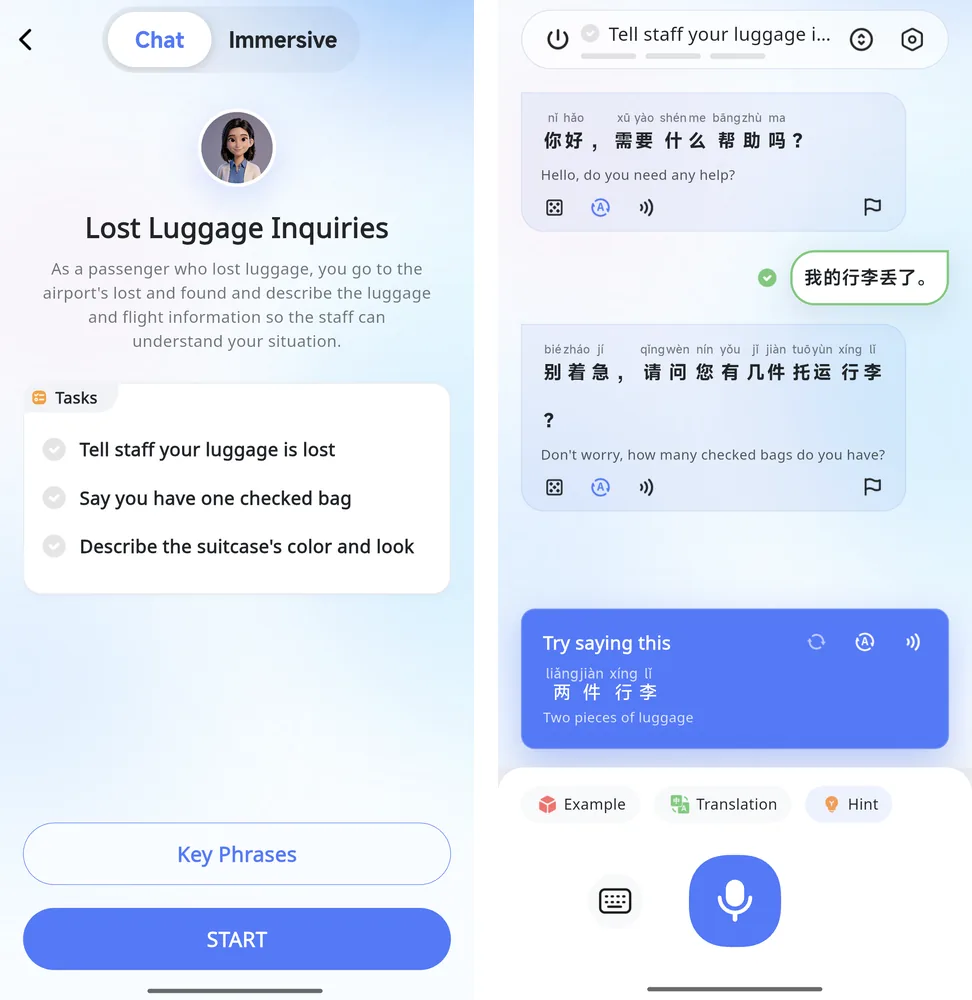
What one task-based conversation looks like
The lost-luggage lesson shows how the tasks shape a conversation. Its scene card puts you at an airport lost-and-found desk as a passenger whose bag has not arrived. Your three tasks: report the missing luggage to the staff, give the number of checked bags (one), and say what color the suitcase is and what it looks like. In our run of the lesson, the tutor opened with 你好,需要什么帮助吗? ("Hello, do you need any help?"). We answered 我的行李丢了 ("My luggage is lost"), and in that chat the tutor moved on to checked bags: 别着急,请问您有几件托运行李? ("Don't worry. How many checked bags do you have?"). For that question, the suggestion card offered 两件行李 ("two pieces of luggage") as one possible answer.
The second task carries its own grammar point. The tutor's question used 几件 (jǐ jiàn, "how many"), with 件, the measure word Chinese uses for pieces of luggage. To answer, you have to put a number and 件 together in a sentence of your own.
The third task asks for color and appearance words, the same kind of describing language the course builds toward at Level 2. The tasks are checked off by what you say or type in the chat, so each one asks you to put a sentence together. For the suitcase, that means using a color word and describing how it looks.
Help when a full sentence will not come
SureChinese keeps several kinds of support inside the conversation. To understand the tutor, you get pinyin on each line and an English translation you can show or hide. To get started on a reply, a suggestion card proposes a short sentence you could say, like the 两件行李 above, and a sample-answer option offers three complete replies. To say something you can only phrase in English, a translation tool turns your English into Chinese.
How much of that support appears automatically is your choice. The conversation settings switch between Beginner mode, which keeps automatic translation and hints on, and Advanced mode, which hides the tutor's text and turns automatic translation and hints off. A learner coming from a general app can start with the support on and lean on it less as replies get longer.
Feedback on the sentences you say out loud
Open conversation has no answer key, so a reply that felt fine may still contain a mistake. SureChinese gives spoken replies in Talk two kinds of feedback. A grammar view checks the wording. When a sentence needs work, it shows your version next to a rewritten one with a short explanation in English, and a practice option lets you say the corrected sentence. When the wording needs no change, the reply is marked as fine. Grammar refinement is part of Premium.
The second view covers pronunciation, with an overall score split into three parts. Accuracy compares your sounds with a native speaker's, Fluency rates how smooth the delivery is and whether it stalls, and Completeness counts how much of the sentence actually got said. A reply can be smooth but miss a word, or complete but halting, and the three parts show which of those happened.
After a spoken conversation, a study report counts the tasks you completed and the sentences you spoke, picks out your best sentence with a replay of your own recording, and lists your spoken sentences one by one with scores. That gives you a short list of lines to say again.
Putting the course and the conversations together
Keep the course lessons going alongside Talk practice, and let the feedback on your spoken replies decide what to review. When the grammar view flags a sentence, say the corrected version a few times and note the pattern so you meet it again. Finished conversation lessons can be opened again, so a scene that went badly can be run a second time with the corrected sentences ready. Before any new scene, the Key Phrases preview is a quick way to hear the scene's main sentences, which helps when a scene uses words the course has not reached yet.
On a second run, compare your replies with the first: how long they are, how often you reach for the suggestion card, and which sentences still come back rewritten. The study report and the grammar view keep your own sentences on record, so the comparison is there to make.
The Talk lessons cover a range of everyday scenes, such as planning a trip, checking into a hotel, shopping at a fruit store or a supermarket, and dealing with a failed online payment.
Who this next step suits
SureChinese fits learners who have the basics from a general app and now want two things at once: a course that shows the path through HSK 1 to 4, and regular practice turning that material into spoken sentences. It suits people working toward the HSK, travelers who want to handle situations like a lost bag or a hotel desk, and anyone who has noticed that recognizing words has stopped being the hard part. For an HSK candidate, the four levels give each stretch of study a clear place on the exam scale; for a traveler, the Talk scenes put the same words into situations that come up on a trip. Learners who mainly want a reading or vocabulary drill tool will use only part of what it offers.
Frequently asked questions
Does SureChinese teach only Chinese?
It does. SureChinese is a Chinese learning app, so its courses, conversations and feedback are all about Mandarin, from pinyin and characters to spoken replies in everyday scenes. The interface itself comes in 12 languages, English among them.
Which HSK levels do the SureChinese courses follow?
The main course has four levels matched to HSK 1 through HSK 4. Units inside each level follow a topic, and pinyin has a course of its own for anyone revisiting pronunciation.
Can I practice speaking Chinese without a live partner?
An AI tutor takes the other side of the conversation in SureChinese's Talk lessons. Each lesson sets a scene with three tasks, and your spoken replies receive grammar and pronunciation feedback, and Premium adds grammar refinement to that feedback.
Can I type my replies instead of speaking?
Typing works in the conversations as well, and the tutor carries on either way. The grammar and pronunciation feedback comes with spoken replies, so speaking adds that layer on top of the sentence-building, which matters for anyone whose goal is to speak.
How does the SureChinese subscription work?
SureChinese offers limited free access to its courses and speaking practice. A Premium plan opens the full course and unlimited speaking practice, billed monthly, quarterly or yearly, and current prices are shown in the App Store and Google Play.
Download SureChinese, open today's Talk lesson, and finish its three tasks out loud.