
Is There an App That Records My Mandarin and Tells Me If My Tones Are Correct?
SureChinese records your Mandarin, scores each attempt and marks the words that need work. In a recorded demo, every changed tone was marked on the word it belonged to. Here is how to use that feedback to fix tones.
Mandarin tones are hard to judge in your own voice. A learner practicing alone usually cannot hear their own pitch while speaking, so a single overall score is not enough: the feedback has to land on a specific word, and there has to be a way to hear the difference between your version and a native one. Without both, a low score only says that something went wrong, not where or how to fix it.
SureChinese puts its feedback on the word itself. Read-aloud questions record you, score the attempt and color the characters. When we changed the tone of one word at a time in a demo sentence, that word was marked every time. With the model audio a tap away, you can then hear exactly how the marked word should sound and say it again.
Pronunciation feedback in SureChinese, word by word
Built around speaking, SureChinese combines HSK 1–4 courses with practice against an AI tutor. Instant pronunciation feedback, for fixing your tones in real time, is one of its three headline features. For tone practice, these are the features to use:
- Read-aloud questions marked by word. Each attempt gets a score, and the characters are colored so the words that need work stand out.
- Model audio next to your own recording. A speaker plays the native model, and a playback control replays what you just said.
- Tone units in the Pinyin Course. Lessons on the four tones, tone marks, the neutral tone and tones across two- and three-syllable words.
- Scores for spoken replies in conversation. Replies you speak to the AI tutor get a pronunciation score as well.
Read-aloud feedback that points to a word
Course lessons in SureChinese include read-aloud questions, and the unit quizzes use them too. Each card gives a short sentence in characters, with pinyin above and the English meaning below. You record yourself, and the result appears as soon as you stop: a score and the sentence redrawn in color. The color guide labels green as "great" and red as "needs work," so the words to revisit stand out against the rest of the sentence.
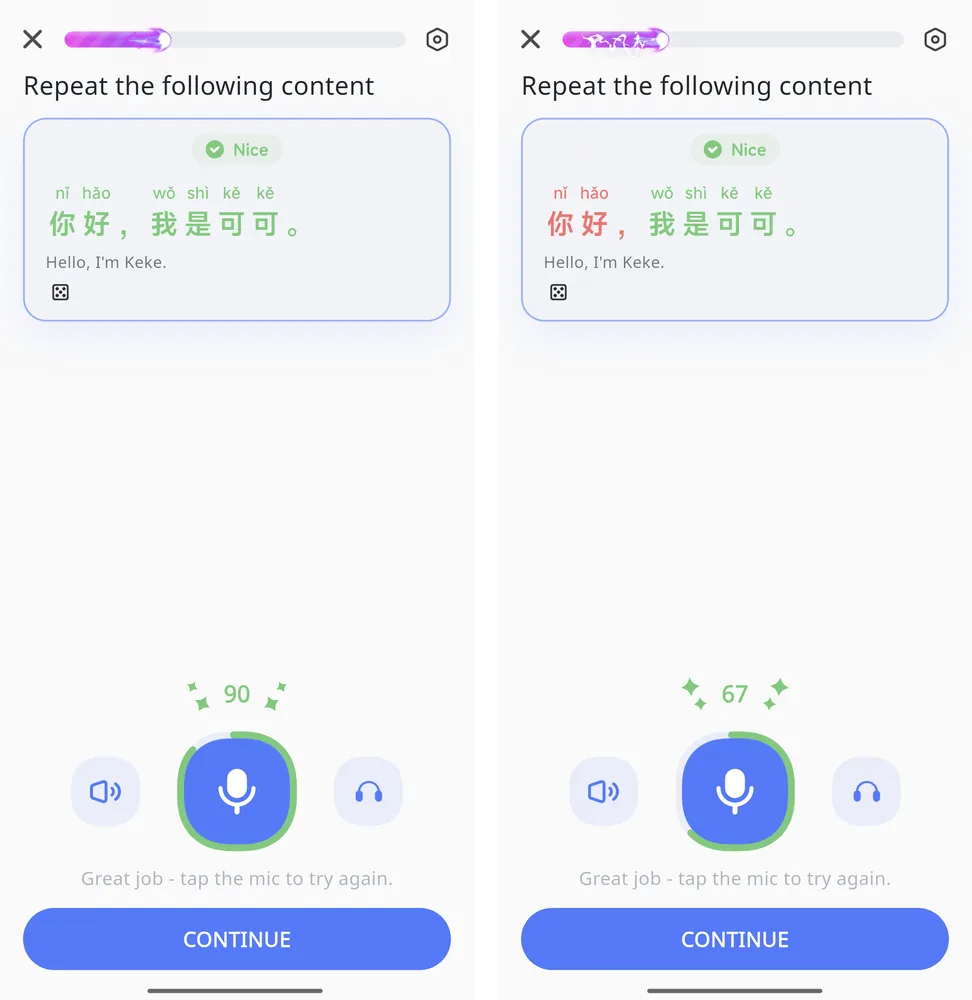
A total of 67 tells you the attempt was weaker than one scoring 90, but it does not tell you which syllable slipped. Colored characters narrow it down to a word or two. When one word turns red while the rest of the sentence stays green, you know where to listen first.
Working on whole sentences matters for tones. Some tones change next to each other, and a word said perfectly in isolation can shift when it sits in a sentence. The everyday greeting 你好 (nǐ hǎo, "hello") is a familiar case: both syllables carry the third tone on paper, but when two third tones meet, the first is said as a rising tone, so the greeting sounds closer to ní hǎo. The negative 不 (bù, "not") shifts in a similar way before another fourth tone. A mark on a specific word inside a sentence therefore tells you more than a score for the sentence as a whole.
The microphone stays ready after each result, so you can record again straight away and see whether the colors change.
One greeting, recorded several ways
Here is a real example from the app: we recorded one short sentence from a unit quiz, 你好,我是可可 ("Hello, I'm Keke"), several times in the English interface. A native Mandarin speaker read it, changing the tone on one word at a time and confirming each reading on the spot.
The first recording, read correctly, scored 90 and came back entirely green. In the next one, 好 (hǎo, "good," the second half of "hello") was said in the fourth tone as hào; the score was 67 and 你好 turned red.
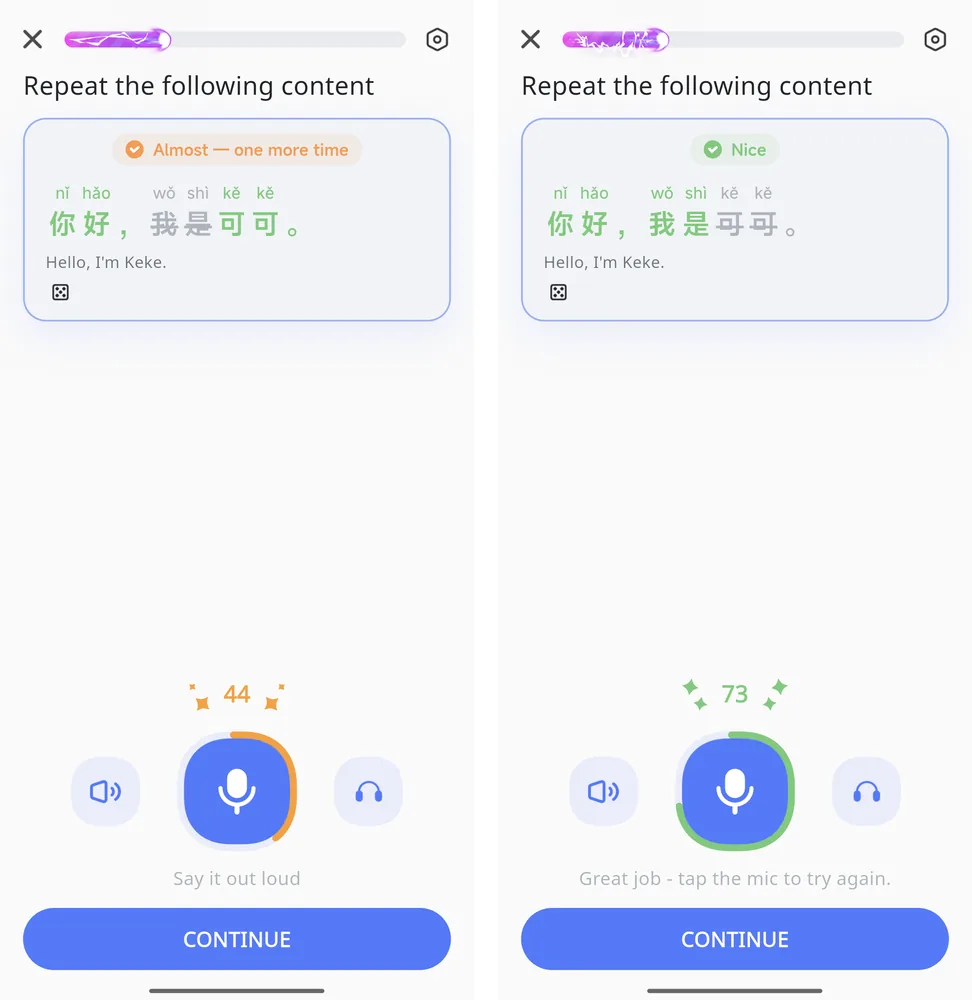
With 是 (shì, "to be") said as shǐ, another recording scored 44, and 我是 ("I am") was marked. With the name 可可 (Kěkě) said with fourth tones, the score was 73, and 可可 was marked. Each time, the marked characters included the word whose tone had been changed, sometimes along with a neighboring character. Playing the model audio and then your own recording lets you hear exactly what to change.
Comparing your recording with the model
Fixing a marked word comes down to hearing the pitch difference between your attempt and a native reading.
Tones are pitch patterns: high and level, rising, dipping, or falling, plus a light neutral tone on some syllables. Speakers of non-tonal languages already use pitch, but for emphasis, questions and emotion rather than for word meaning, and that habit pulls against Mandarin. A yes-or-no question in English often rises at the end; a Mandarin question can end on a falling syllable and still be a question. So a learner's ear tends to accept a wrong tone as normal intonation, especially in their own voice.
The tones also behave differently from how they are drawn on charts. The third tone is shown as dipping and rising, but in ordinary speech it is often said low without the rise, and the neutral tone on syllables such as the question particle 吗 (ma) is short and light. A learner who practices only the chart shapes can end up exaggerating tones in a way that still sounds wrong to a native ear.
Hearing that difference takes practice of its own. It helps to listen for one feature at a time: where the pitch starts, which way it moves, and whether the syllable ends higher or lower than it began. A falling fourth tone, for example, starts high and drops quickly, while a rising second tone starts in the middle and climbs. Some learners find it easier to hum the pitch line of the model before saying the word, or to trace its direction with a hand while speaking.
SureChinese keeps both recordings on the same card. One control plays the model audio. After you record, another replays your own attempt, so you can listen to the two back to back.
A simple loop works well for each read-aloud sentence. Record once at a natural pace before listening to the model, so the first result reflects your habits. Then play the model audio and your own recording back to back, listening only to the marked word. Finally, say that word on its own a few times with the model's pitch, put it back into the sentence and record again. Check which words are still marked after the new attempt, and note down any that stay marked across several tries.
Tone lessons for the pattern behind the mistake
Some tone errors are not one-off slips but gaps in the rules. SureChinese's separate Pinyin Course works through the sound system step by step: initial consonants, then finals, then tones, then pinyin rules. Its unit on the four tones comes with lessons on the tones themselves, on tone marks and on the neutral tone, followed by a quiz lesson. Other units cover tone combinations in two-syllable and three-syllable words, working through pairings that start with a first tone, then a second, third and fourth tone. That is where many learners' tones break down once single words are no longer the problem, because each pairing has its own shape to learn.
When comparing recordings shows that a certain tone pairing keeps giving you trouble, the two- and three-syllable units are organized around those pairings. For background on how each tone sounds and how to tell them apart, the SureChinese blog also has a guide to the four tones, and a beginner's guide to pinyin covers the tone marks.
Unit quizzes give a checkpoint that is not the same sentence repeated. They include read-aloud questions alongside picture and listening questions, so a quiz is a natural moment to see whether words you worked on earlier now come back unmarked. The greeting in the demo above comes from one of those quizzes, and read-aloud questions there use the same color feedback as regular lessons.
Tone practice also continues outside the lessons. Spoken replies in conversations with the AI tutor get their own pronunciation rating, with separate figures for accuracy, fluency and completeness, so pronunciation can be checked in sentences you put together yourself rather than only in sentences you read. Conversation lessons are set in everyday situations, such as checking in at a hotel, which gives the tones you practiced on read-aloud cards a place to be used in your own words.
Who this kind of tone feedback suits
SureChinese suits beginners and self-taught learners who already know pinyin and want a regular way to check their tones without a teacher listening. It is a good fit for anyone who finds that a word sounds right in their head but not when recorded, for learners whose tones hold up in single words but slip once the words are joined into a sentence, and for learners who want feedback on specific words rather than a single grade. Complete beginners who have not met the four tones yet are better served by starting with the Pinyin Course's tone unit and coming back to read-aloud practice once the basic pitches are familiar.
Frequently asked questions
How does SureChinese show which tone needs work?
SureChinese scores each read-aloud attempt and colors the characters. The color guide labels green as "great" and red as "needs work," so the word to revisit stands out. Replaying your recording next to the model audio then lets you hear what to change.
Can I listen to my own recording in SureChinese?
Yes. After you record a read-aloud sentence, a playback control replays your attempt, and another control plays the model audio. You can switch between the two and record again on the same card.
Does SureChinese teach the four tones?
Yes. The Pinyin Course includes a unit on the four tones, tone marks and the neutral tone, and later units on tone combinations in two- and three-syllable words.
Can I practice tones in conversation, not just in set sentences?
Yes. You can keep practicing in spoken replies to the AI tutor in SureChinese's conversation lessons, where your pronunciation is rated for accuracy, fluency and completeness in sentences of your own.
Open a read-aloud lesson in SureChinese, record one sentence, and compare any marked word with the model audio.