
Which AI Chinese Tutor Is Good for Realistic, Engaging Role-Play Conversations?
SureChinese's Talk lessons give you a role and three tasks, and the AI tutor plays the other person in the scene. The same scene can also be played in a 3D Immersive mode.
Plenty of learners can recite a textbook dialogue word for word and still stall at a real hotel desk. The textbook handed them both sides of the script. A real counter hands them only a role and a job to get done, and the person behind it says whatever the moment needs. Role-play feels real when it copies those three things: a clear identity, a partner who answers in character, and a task you have to finish.
The Talk lessons in SureChinese bring all three into role-play with an AI tutor. Each scene opens with a short brief that sets your role and three tasks, and the AI tutor plays the person on the other side. The same scene can also be switched to Immersive mode and played out in a 3D setting.
What makes a role-play feel like the real thing
Real conversations ask more of you than producing correct sentences. You have to catch what the other person tells you, often a number, a place or a time, and then use it to take the next step. A lot of practice misses this. Learners describe conversations that slide back into English within seconds, or fade into polite smiles because neither side knows what to say next.
Two common forms of practice fall at opposite ends. An open chat with no setting gives you freedom, but many learners freeze because nothing tells them what to talk about. A fully scripted dialogue removes that worry, but the other side only says what you expected, so you get no practice listening for new information.
Good role-play lands between the two. It fixes the situation and the goal, which keeps you from freezing, and leaves the details of each reply for you to catch, which keeps you listening. A useful test: after the scene, could you tell someone what you found out? If the answer is just "I said my lines," the practice was a script.
Four checks help you judge any role-play, whether it runs with a teacher, a language partner or an AI:
- A scene and a role. You know who you are, where you are and what you want. A hotel guest and a hotel clerk use different words and a different tone.
- A partner who answers in character. The replies carry details you must catch, such as a floor number, opening hours or a password, rather than only praise for your Chinese.
- Something to get done. There is a task with a clear finish line, and room to keep talking once it is done.
- A sense of being there, plus a little preparation. The scene should feel like a place, and you should have a few key lines ready before you speak.
The first three make a conversation realistic. The fourth makes it easier to start, which matters most on the days when speaking feels like a big ask.
SureChinese's Talk lessons hand you a role and a goal
SureChinese is an AI app for learning Chinese, built on two parts: structured HSK courses, and speaking practice with an AI tutor that is available 24/7 and needs no live partner. The app's Spiral Speak Method builds toward real conversations with the AI tutor, in your own words.
Each of the four checks has a counterpart in a Talk lesson:
- A scene brief with three tasks. You read who you are and what you need before the first line, so the conversation has a direction.
- An AI tutor in character. The tutor takes the other part in the scene, which is the core of how the AI tutor works in these lessons.
- Two ways to play a scene. Chat mode shows the exchange as a conversation thread; Immersive mode stages it in a 3D setting.
- Key Phrases before you start. A short preview of the scene's key lines, each with audio and an English meaning.
- A clear finish. A progress bar fills as the conversation works through the tasks, and once they are done, the lesson lists all three as completed in a short report.
Take the hotel lesson, Understanding Hotel Amenities. Its brief: "As a hotel guest, after checking in, you ask the front desk about hotel facilities and meal times." The three tasks are to ask if the hotel has a restaurant, ask the breakfast hours and ask for the WiFi password.
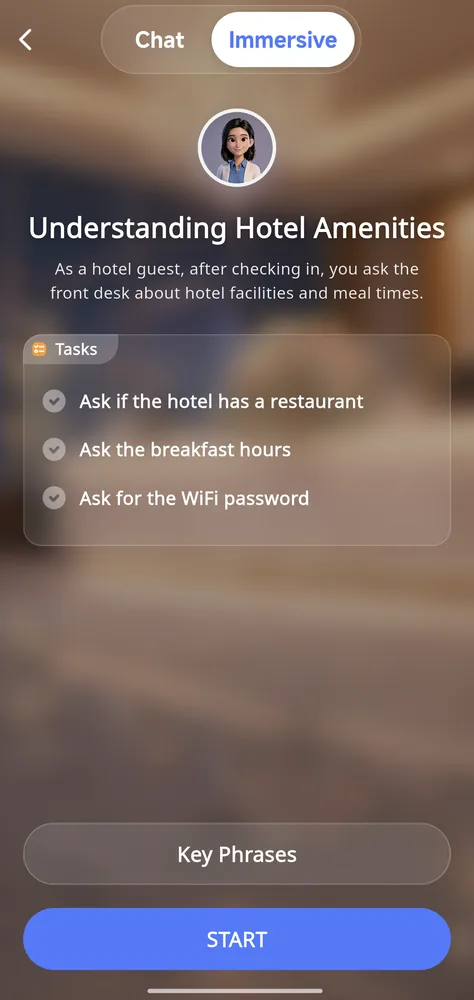
The role decides how you speak. As a guest, you ask politely for information; you do not chat about the weather. The tasks turn "what should I talk about?" into "what do I need to find out?", and that is a much easier question to act on. The setting also takes pressure off: it is a front desk you can walk up to at any hour, with nobody waiting behind you in line.
A front desk that answers like a front desk
A realistic partner gives you information you have to understand, not just encouragement. Here is how the hotel scene in SureChinese played out in Chat mode.
The guest's first question was 酒店有餐厅吗? ("Does the hotel have a restaurant?"). The clerk answered: 有的,餐厅在二楼。您想问早餐时间吗? ("Yes, the restaurant is on the second floor. Would you like to know the breakfast hours?").
The next two exchanges brought two more facts the guest needed to catch: breakfast runs from seven to ten, and the WiFi password is hotel888. After that last answer, the clerk wished the guest a pleasant stay.
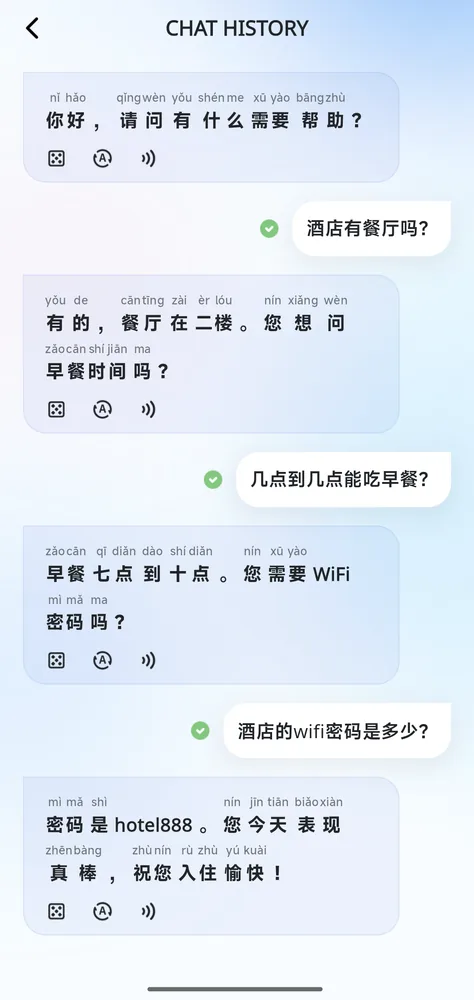
Two things make this exchange realistic. You speak as a guest with a reason to be there. And every answer carries a detail that a real guest would need: a floor, a time range, a password. Miss "second floor" or "seven to ten" and you miss the point of the reply, which is exactly the kind of listening that textbook dialogues skip.
The role shows in the language, too. The clerk addressed the guest as 您 (nín), the polite form of "you" that service staff use with customers, rather than the everyday 你 (nǐ). Small details like this are part of what makes a scene sound like a hotel and not a classroom, and they are worth noticing when you hear them.
The exchange also kept moving. In that conversation, after the first two answers, the clerk pointed the guest to the next task, asking about the breakfast hours and then about the WiFi password. The guest did not have to hunt for a new topic.
For practice, this means you are training two skills at once. You produce a question in the right role, and you pull a specific piece of information out of the answer. Real hotel desks, shop counters and offices ask for both.
Same scene, staged in 3D: Immersive mode
Some learners find it easier to speak when the scene looks like a place rather than a chat window. For them, SureChinese lets you switch the hotel lesson from Chat to Immersive mode.
In Immersive mode, the hotel lesson opens on a 3D receptionist standing in a hotel lobby. A task bar across the top of the screen shows the first task, asking about the restaurant. The receptionist's opening line, 你好,请问有什么需要帮助? ("Hello, how can I help you?"), comes with pinyin and an English translation. Below her, a "Try saying this" card suggests 有餐厅吗 ("Is there a restaurant?"), with the microphone at the bottom of the screen.
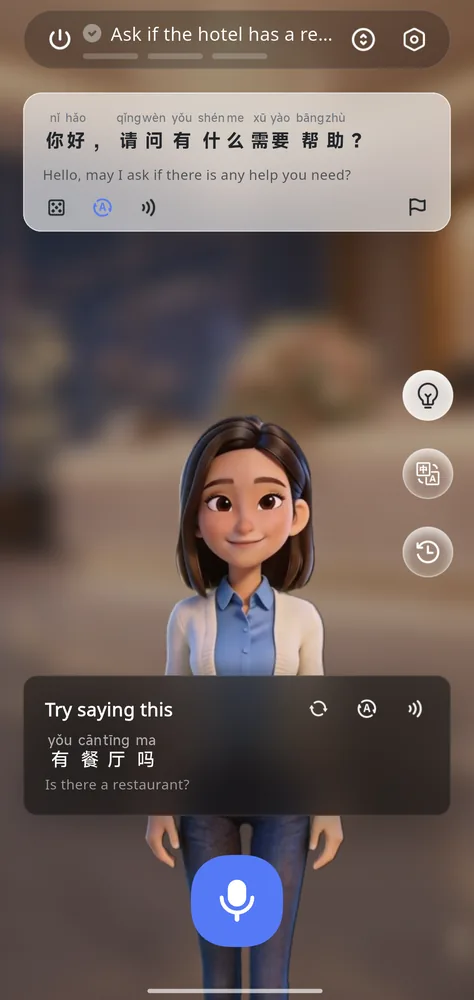
Down the right side of the screen are controls for hints, translation and the chat history. The scene and the tasks stay the same as in Chat mode; what changes is that a person and a room are in front of you. For learners who want the fourth check, a sense of being there, this is the mode to choose.
Rehearse the lines, then close the scene
Preparation and a clear ending are the two things that make role-play easy to start and easy to finish.
Before the hotel scene begins, the Key Phrases preview lists three key lines for the scene, each with audio and an English meaning:
| Key phrase | Meaning |
|---|---|
| 酒店有餐厅吗? | Does the hotel have a restaurant? |
| 几点到几点能吃早餐? | What time is breakfast served? |
| 酒店的wifi密码是多少? | What's the hotel WiFi password? |
Hearing them before the first line gives you sentences to reach for. You still have to choose when to use each one and understand the replies, so the preview supports the conversation without replacing it.
Once all three tasks in the hotel lesson are done, the app shows "All tasks done! Keep chatting, or move on to the next lesson." That gives the scene a real finish line while leaving room to add another exchange. The Study Report then lists the lesson tasks, three out of three, each with a tick.
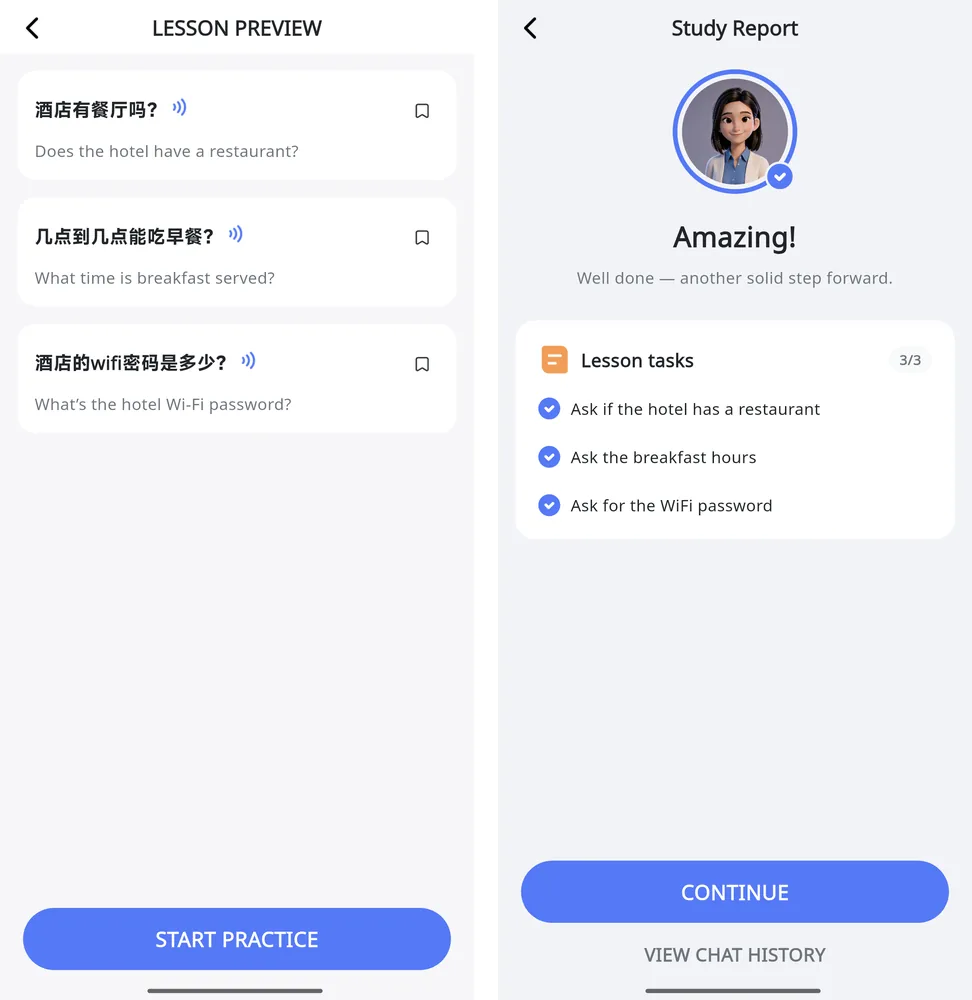
Open practice with no end point tends to drift until you give up, while a scene with tasks tells you when you have done what you came to do. It also makes the next session easier to start, because you know exactly what one finished scene looks like.
Who this kind of role-play suits, and how to get the most from it
SureChinese's Talk lessons, such as this hotel scene, suit learners who already know some basic words and patterns and now want to use them in a situation: checking into a hotel, shopping, sorting out a problem. Complete beginners can follow the tutor's lines with the pinyin shown above them, but the role-play pays off most once you can produce short questions of your own. Our guide to real-life conversation practice looks at more of these everyday scenes.
A simple routine gets more out of each scene, and it works with a teacher or partner as well as with an AI:
- Read the scene first. Know your role and what you need to find out before the first line.
- Preview only the key lines. Three or four sentences are enough; more turns the scene back into a script.
- Speak your part out loud. Even short questions count.
- Listen for the detail in each reply. Pick out the time, place or number, and say it back to yourself.
- Add one more exchange. Once the tasks are done, ask one question the lesson did not require.
To see whether the routine is working, check two things after each scene. Could you repeat the details the other side gave you? And did you get through the tasks with fewer looks at the key lines than last time? Both are signs that the sentences are becoming yours.
The same routine also helps when you practice speaking without a partner on other days, because it gives every session a role, a goal and a detail to catch.
Open a Talk lesson in SureChinese, read the scene first, then switch it to Immersive and play your part.