
Which Bite-Sized Learning App Is Made Specifically for Mandarin Chinese?
SureChinese keeps lessons short and quiz-like, but builds its questions around Mandarin: pinyin on word cards, slow audio, character origins and stroke-order tracing, and a separate Pinyin Course.
A short-lesson app made for Mandarin has to connect four things across its quick questions: the sound of a word, its spelling in pinyin, its meaning and the character it is written with. Mandarin asks a beginner to hold all four at once. Words carry tones that change their meaning. Characters give only partial clues to how they are pronounced. And most learners first meet a word through pinyin, the romanized spelling, before they can read it. A quick question that shows a character with no pinyin, or plays audio once at full speed, leaves a beginner guessing.
SureChinese teaches only Mandarin, in short, quiz-style lessons whose questions put pinyin, tones and characters next to each other, so the sound, the spelling, the meaning and the written form of a word stay connected.
Built for Mandarin from the first exercise
New Oriental Education backs SureChinese, an app for learning Chinese that combines leveled HSK 1–4 courses with an AI conversation tutor. Its courses are bite-sized lessons that build listening, speaking, reading and writing together. Four features make those short lessons specific to Mandarin:
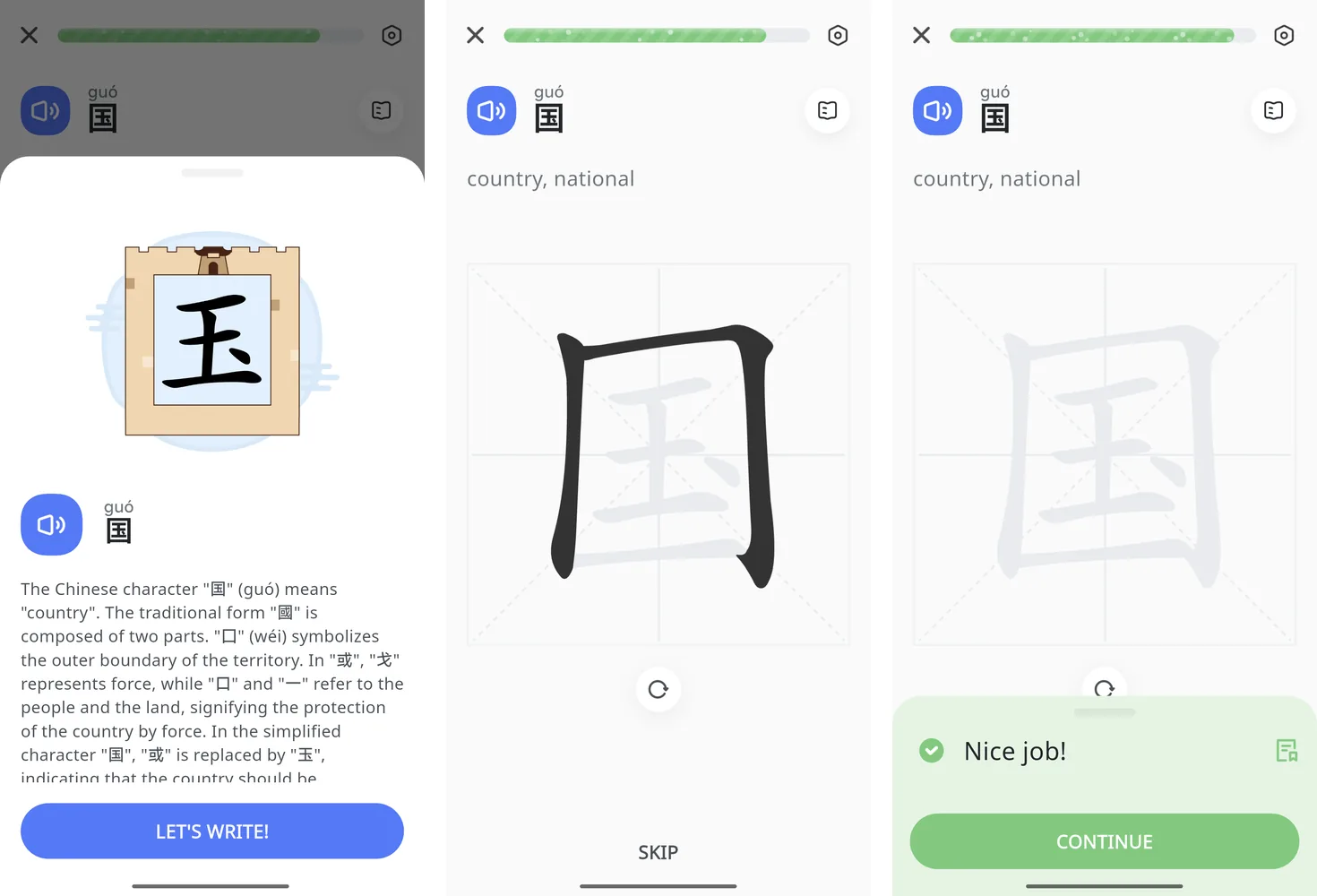
- Character explanations with stroke-order tracing. New characters such as 国 (guó, "country") come with a note on where the shape comes from, followed by tracing practice.
- Pinyin and meaning beside the sound. Word cards, read-aloud sentences and sentence-building tiles show pinyin, with English where you need it.
- Listening you can slow down. Listening questions can include a slow-audio option for a second, clearer hearing.
- A separate Pinyin Course. A course of its own for initials, finals and tones.
Characters explained, then written stroke by stroke
Chinese characters are hard to remember as abstract shapes, and they become easier once the parts mean something. SureChinese introduces new characters such as 国 with a character card that explains how the form came about, with a speaker so you hear the character as you read about it, then moves straight to stroke-order tracing. The explanation and the tracing appear in the same lesson as the vocabulary questions around them, so a short session covers what a character means, how it is built and how its strokes go, without a separate writing drill.
What one character card looks like
To show how a card works, we opened the one for 国 (guó, "country") in a Level 1 lesson on countries and nationalities. It explains the traditional form, 國, in two parts. An outer frame, 囗, stands for the boundary of a territory. Inside it, 或 is read part by part: 戈 represents force, while 口 and 一 refer to the people and the land, together suggesting a country protected by force. In the simplified character 国, the card notes, 或 is replaced by 玉 (jade).
Writing comes next: an animation shows the stroke order, and we traced the character over a gray outline until it was complete. Each stroke turns black once it is written, and the finished character gets a short message of praise. A replay control under the grid plays the stroke animation again, and a skip option is also available. The same lesson also uses 中国 (Zhōngguó, "China") and 美国 (Měiguó, "the United States") in its picture and listening questions, so the character shows up inside whole words as well as on its own.
国 is not the only one. Character cards in other lessons explain 是 (shì, "to be") and 叫 (jiào, "to be called") in the same way, part by part. The card for 叫 splits it into 口 and 丩 and explains that the character first referred to loud sounds, then came to cover calling someone over, naming and giving commands. At HSK 4, the card for 景 (jǐng, "scenery") explains that its upper part, 日, represents sunlight and its lower part, 京, provides the pronunciation, which is the partial sound clue many characters carry. On that 景 grid, after three off-course attempts in a row, the stroke due next appeared in gray. Later in that HSK 4 lesson, a video listening question uses the character inside 风景 (fēngjǐng, "scenery"), in a sentence about autumn in Beijing.
Pinyin and meaning beside the sound
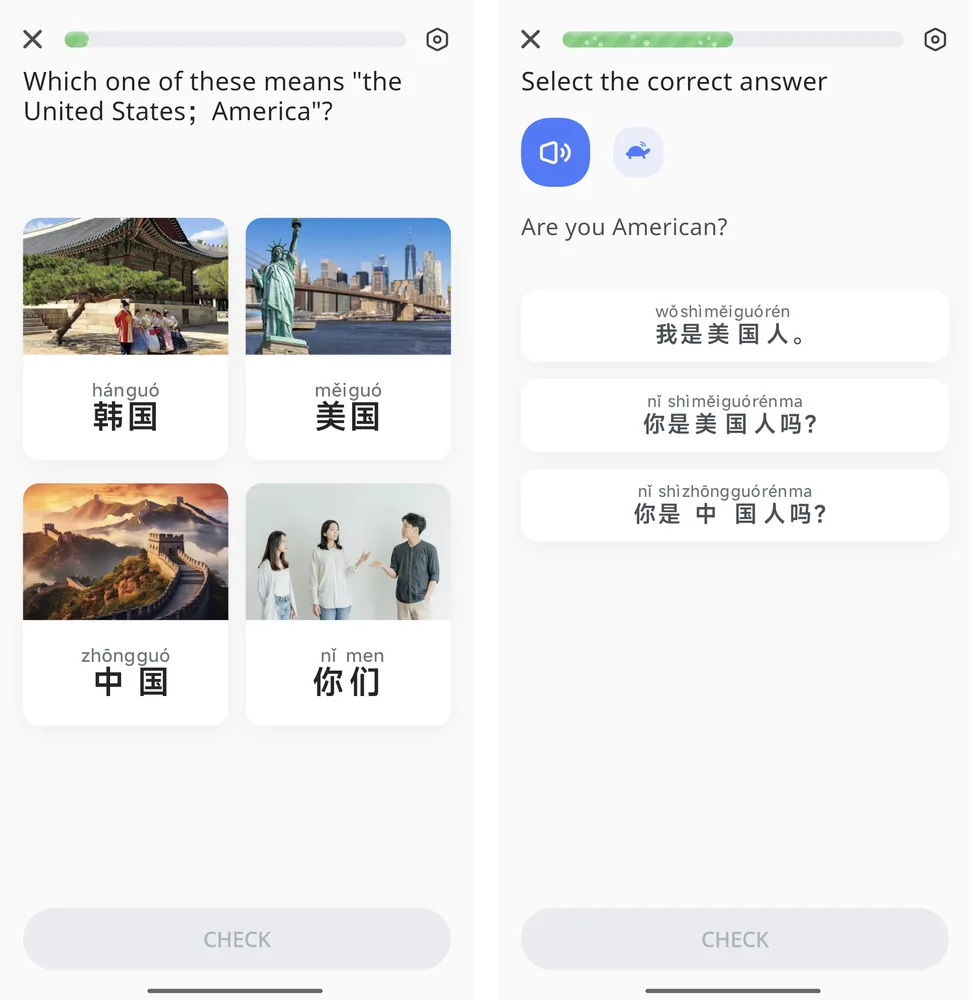
Hearing a Mandarin word without seeing it spelled makes it hard to pin down, especially when the tone is new. SureChinese keeps pinyin close to the words in its questions, so the sound, the spelling and the character are in view together. In a picture question, the photo options show pinyin above their characters, and the English prompt, such as "the United States; America," supplies the meaning. Read-aloud cards add an English translation to the pinyin and characters, so you know what a sentence means before you say it. For a beginner, this means a question does not have to be a guess at an unreadable character, even in the first week.
Sentence building runs in both directions: Chinese tiles to arrange for an English sentence, such as 他 / 叫 / 王小明 for "His name is Wang Xiaoming.", and English tiles to show you understood a Chinese one. The first trains Chinese word order, the second comprehension.
Listening you can slow down
Mandarin at natural speed blurs syllables together, and tones are easier to hear when the audio slows. A tone is the pitch pattern of a syllable, high and level, rising, dipping or falling, and at full speed the differences are short enough to miss. In SureChinese's listening questions, a speaker plays the audio, and some of them add a turtle-shaped control that plays it again slowly. In the lesson on countries, for example, you hear the Chinese for "Are you American?" and choose between three options that differ in a few syllables: 我是美国人, 你是美国人吗 and 你是中国人吗. The slow replay lets you catch which words were said before you answer. The same lesson uses 美国 as a picture card, a listening option and part of a sentence, so you meet the word by sight and by sound more than once.
Other listening questions use short videos of people saying a sentence, followed by a choice of what you heard. Seeing real speakers adds mouth shape and context to the sound, which helps with syllables that are easy to confuse. When an answer is wrong, the lesson shows the correct one before moving on, so the right pairing of sound and characters is the last thing you see for that question.
Speaking inside the short lessons
A Mandarin-specific lesson also has to get you saying the words, since producing a tone is a separate skill from hearing it. SureChinese's lessons include read-aloud questions. The card shows a sentence in pinyin and characters with an English translation, a speaker plays the model recording, and you record yourself. A short tip card that uses 我们学汉语 ("We study Chinese") explains what the two colors mean. In the English interface, the result arrives as a score, with the characters colored green for great and red for needs work, and you can replay your own recording to compare it with the model. When we read the HSK 4 sentence 北京的夏天挺热的,还经常下雨 ("Summer in Beijing is quite hot, and it often rains"), it scored 99 and every character turned green.
Those questions come mixed in with the picture and listening questions rather than in a separate speaking module, so words from the picture questions, such as 你们 (nǐmen, "you," plural) and 中国, come back in a sentence you then say: 你们是中国人吗? ("Are you Chinese?").
A separate course for the sounds themselves
Some learners want to work on pronunciation directly, apart from vocabulary. SureChinese offers a separate Pinyin Course next to its main course. It covers the consonants and vowels that make up Mandarin syllables, then the tones and how they combine across words. Its first lesson, on b, p, m and f, keeps the same short-question format: you pick the correct pronunciation from three audio options, watch a teacher say a sound and choose the pinyin you heard, and answer listening questions with the slow-audio control. Working on those pieces in isolation makes them easier to hear when they turn up again inside words and sentences. Learners who arrive with some vocabulary but shaky tones can go back over the sounds there without restarting the main course.
Who a Mandarin-only short-lesson app suits
SureChinese suits beginners who like the rhythm of short, quiz-style lessons but want those lessons to center on Mandarin. It is a good match for learners who want to read characters rather than rely on pinyin forever, since character cards and tracing appear inside the lessons, and for learners who struggle to hear tones at full speed and want pinyin and English on the word cards while their ear catches up. Because the main course follows HSK 1 to HSK 4, beginners who expect to sit the first HSK levels also get short lessons that line up with that path. Heritage learners who already speak some Mandarin at home can also use it to build the reading side, through the character cards and pinyin.
Frequently asked questions
Does SureChinese teach Chinese characters or only pinyin?
Both. Word cards and sentences show pinyin, and new characters such as 国 come with an explanation of their form and stroke-order tracing. At HSK 4, the card for 景 also points out that its lower part, 京, gives the sound. For more background, read our guide on whether you need to learn characters.
Can I slow down the audio in SureChinese?
Yes. Listening questions with a turtle-shaped control replay the audio slowly, and read-aloud questions also let you replay the model audio and your own recording.
Which levels do the SureChinese courses cover?
The main course has four levels that follow HSK 1 through HSK 4, split into topic-based units of short lessons. A separate Pinyin Course covers the sound system.
Can I use SureChinese if English is not my first language?
Yes. SureChinese runs in 12 interface languages, including Spanish, Vietnamese, Thai, Indonesian, Russian, Arabic, Japanese, Korean, Khmer and Bengali. In the Spanish interface, question instructions, word meanings, sentence-building tiles and conversation translations appear in Spanish.
Is there speaking practice in the short lessons?
Yes. In the English interface, read-aloud questions grade each recording and mark the characters in color. Beyond the lessons, SureChinese's Talk section has conversations with an AI tutor, who replies to what you say and gives feedback on spoken replies.
Install SureChinese, open the first beginner lesson, trace the first new character it gives you, and record one sentence next to the model audio.