
What Chinese Learning App Can I Use in Small Game-Like Chunks Every Day?
SureChinese breaks Chinese practice into short, game-like pieces: matching and picture questions, a score with a redo of missed answers, a streak, bookmarks and a daily expression.
Studying a language in small daily pieces asks two separate things of an app. Each piece has to be something you can finish in one sitting, with a result you see straight away, so a short session still feels complete. And there has to be an obvious place to start the next day, plus some visible record that you have been showing up. Formats that feel like a game help with the first, because a quick round of matching or picking is easy to start and gives an immediate right or wrong.
SureChinese is built from pieces of that size. Its course lessons are runs of short interactive questions that end with a score, and around them are a streak record, bookmarked questions you can reopen as practice and a daily Chinese expression to hear and say.
Short pieces that fit a day
SureChinese is a Chinese learning app with AI speaking practice and structured courses for HSK 1–4. For learners with about ten minutes a day, the app breaks practice into small pieces:
- Matching pairs and picture questions. Quick interactive questions, each checked as soon as you answer.
- A score at the end of a lesson. You see how many answers were right and can redo only the ones you missed.
- A streak record. A day-by-day view of when you practiced, plus a flame counter on the home screen.
- Bookmarked questions. Questions you save during lessons reopen later as a short practice set.
- A daily Chinese expression. One phrase a day with audio, a meaning and a chance to say it yourself.
A day's practice can be one of these pieces or several of them, depending on how much time the day leaves.
Lessons made of quick, game-like questions
A SureChinese course lesson is a sequence of short questions, and the question types change as you move through it. Some show four photos and ask which one matches a word, with pinyin on each option. Some play a line of audio and ask you to choose the sentence you heard. Others ask you to build a sentence from word tiles, fill a gap under a picture, or read a sentence aloud and get a score.
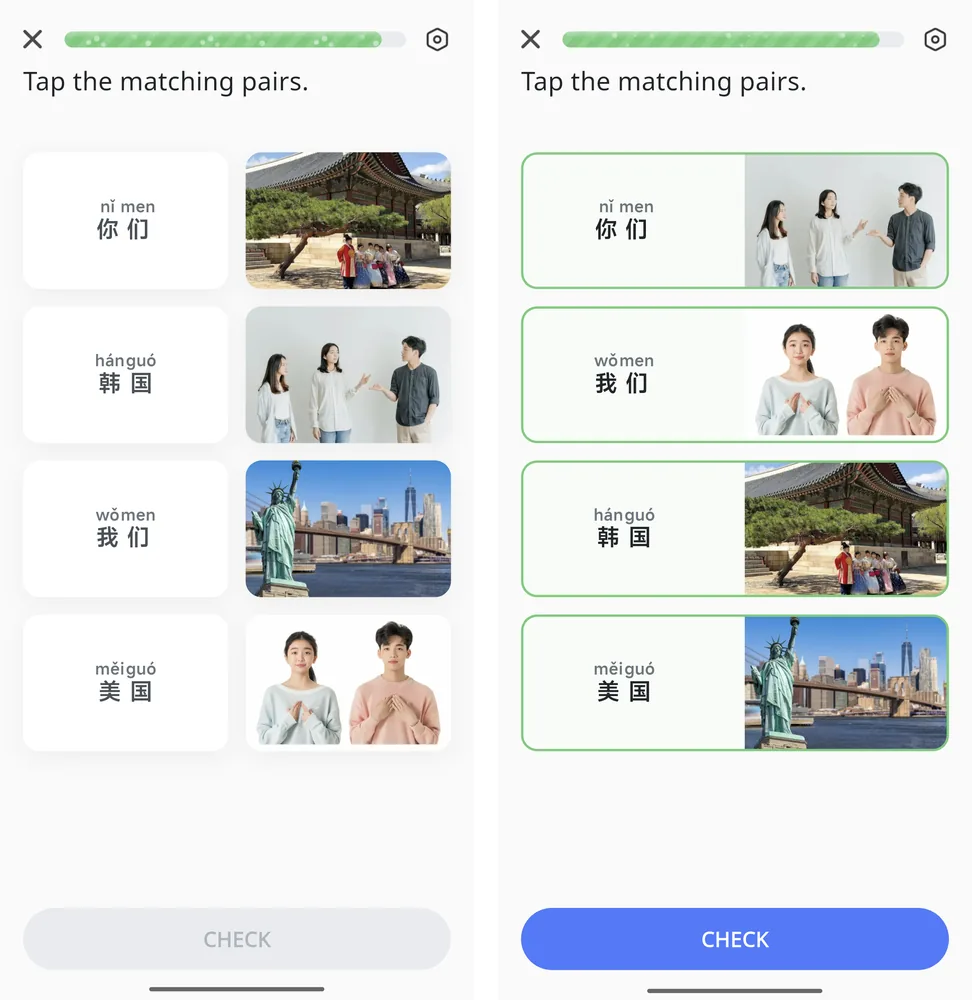
Matching pairs is the most game-like of them. You pair a set of Chinese words, shown with pinyin, with the photos they describe, and each correct pair locks together until the board is complete. Once the last pair is in place, a Check button takes you on. It works like a small puzzle, and it tests recognition of several words at once instead of one at a time.
Answers are checked straight away. A right answer brings up a short green message such as "Nice job!" or "Perfect!" and moves you on. Answer several in a row correctly and a Focus marker appears above the progress bar with a count, such as Focus × 2, much like a combo counter in a game. A wrong one brings up a red Incorrect bar with the correct answer underneath, and you tap Got It before you continue, so a mistake does not wait until the end of the lesson to surface.
Speaking is part of the same lessons. In a read-aloud question, you hear a short model sentence, say it yourself and receive a score. A clean reading turns the sentence green, with the prompt "Great job - tap the mic to try again."
A lesson that switches between seeing, hearing, matching and speaking practices the same handful of words in several ways before it ends. That suits learners who remember a word better once they have both heard it and said it.
One lesson from start to score
Take a Level 1 lesson on countries and nationalities, which we worked through from the first question to the result page. Its matching question pairs 你们 (nǐmen, "you," plural), 我们 (wǒmen, "we"), 韩国 (Hánguó, "South Korea") and 美国 (Měiguó, "the United States") with photos of people and places. The lesson has 14 questions in total. We got 12 of them right, and the result page opened with "Excellent!" above a score of 85, then offered a review of the two incorrect answers.
A score that closes the lesson, and a second try at what you missed
SureChinese course lessons end with a result page that opens with a short message matched to the result, from "Excellent!" or "Nice job!!" on a strong run to "Don't Give Up!" on a harder one. Below it are the score and the number of right and wrong answers, plus an option to redo only the questions you got wrong. A lesson with two misses leads to a redo round of two questions, and that round ends with its own result page, so the follow-up is a complete piece too. You can revisit the missed questions while the lesson is still fresh.
Saved questions add a second way to revisit material. After you answer, the feedback bar carries an icon that saves the question. Any question you bookmark this way goes into My Bookmarks, and opening that list starts the questions again as practice rather than showing a static list to read. A bookmarked sentence-building question, for example, comes back as the same exercise, ready to arrange.
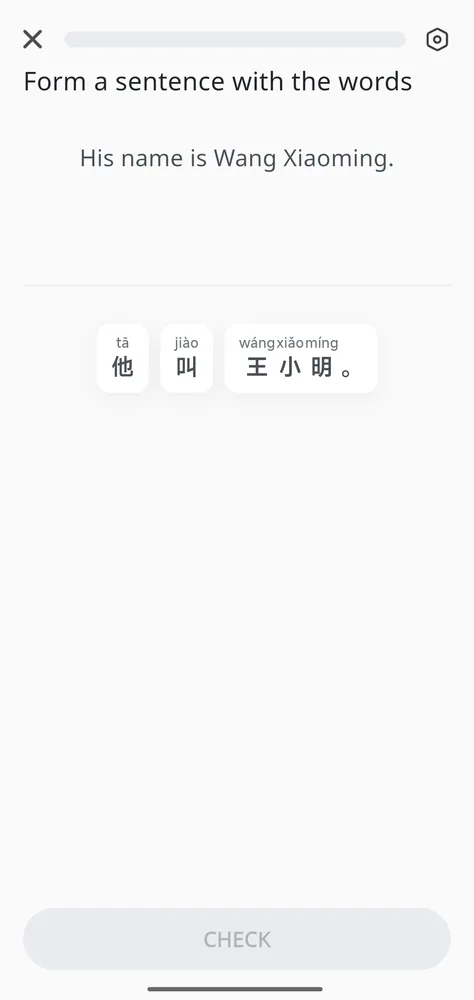
For the shortest sessions, the bookmark list gives you something specific to open. Instead of starting a new lesson you may not finish, you can go back through the handful of questions you chose to keep, in the same format you first met them.
A streak that shows which days you showed up
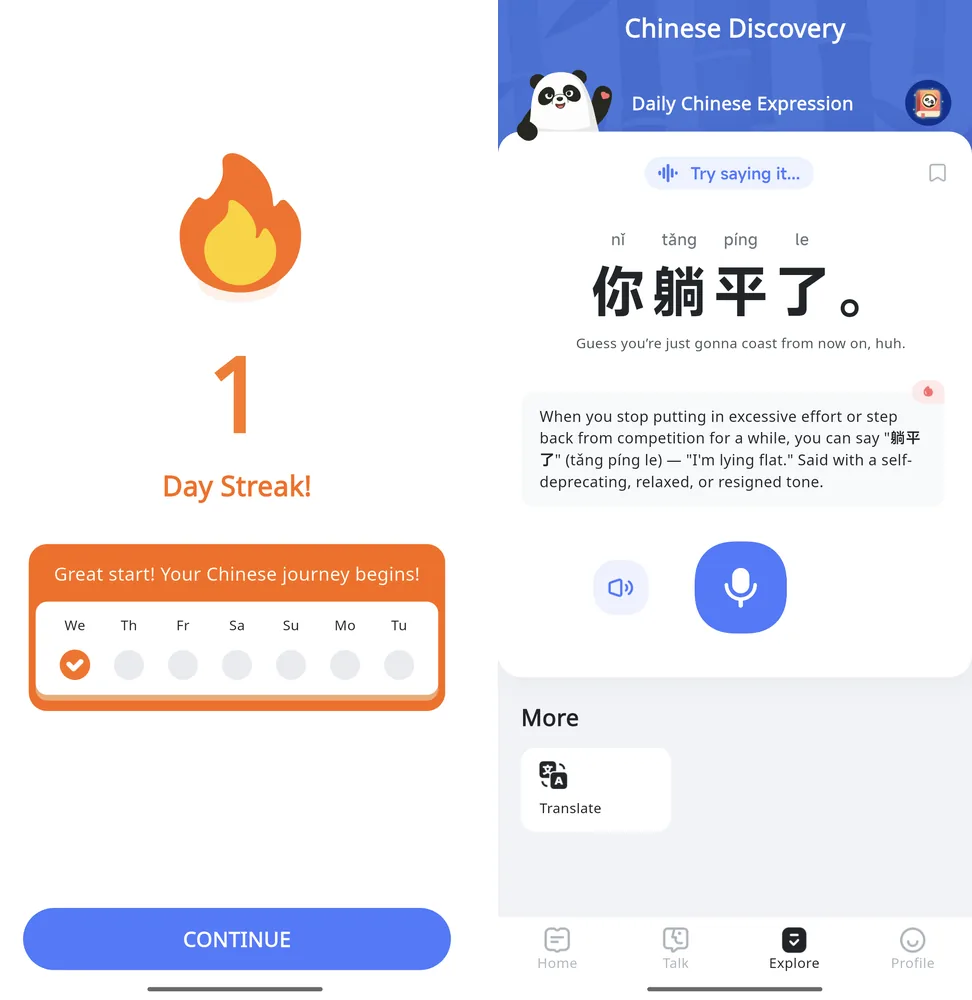
SureChinese keeps a streak of the days you practice. When we finished one conversation lesson, a Day Streak page came up with the message "1 Day Streak! Great start!" and a week row with the practice day checked off. A flame counter on the home screen keeps the number in view between sessions.
Conversation lessons with the AI tutor add a spoken piece to the day. Each conversation lesson has three tasks, and the Today slot in the Talk section shows the next lesson to open. The home screen can also point you there, with a message naming the tutor and the topic of today's conversation lesson, such as Travel Planning.
For someone fitting Chinese around work or school, the week row is a quick way to see which days already have practice in them. Settings also include a study reminder, introduced with the line "Set study reminders to achieve your goals," with a switch to turn it on.
A daily expression for the shortest days
Some days allow very little time. For those, SureChinese's Explore section shows a Daily Chinese Expression: one phrase with pinyin, an English rendering, a note on when people use it, model audio and a microphone under a "Try saying it" prompt, so the phrase is something you say as well as read. Expressions can be bookmarked, and earlier ones stay in a history list with All and Saved tabs, the newest entry marked New. That list doubles as a small phrasebook built one day at a time.
Cards have included informal, everyday expressions, including internet slang such as 太6了 (tài liù le), rendered as "So cool!" Another example is 你躺平了 (nǐ tǎng píng le), with the English rendering "Guess you're just gonna coast from now on, huh." Its note explains that 躺平了 means "I'm lying flat," something people say when they step back from too much effort or competition, in a self-deprecating, relaxed or resigned tone. The usage note gives the expression's context and tone alongside the translation, so you know when the phrase fits a conversation.
Fitting the pieces into a real day
You can choose an activity to fit the time and setting. A course lesson suits the longest gap in your day, since it runs from first question to score in one sitting. The redo round or a few bookmarked questions suit a shorter gap, such as waiting for a train. The daily expression suits the moment you would otherwise skip practice entirely. A conversation lesson fits a time when you can speak out loud, such as a walk home or a quiet room before dinner.
You do not have to complete every activity in one session. On a day with a single free slot, one course lesson and its redo round make a complete session. On a day with more time, you might add the expression and a conversation lesson. On a shorter day, one piece is enough, and the next lesson stays in the course where you left it.
Who daily bite-sized practice suits
SureChinese suits beginners who study in the gaps of a day: on a commute, during a break, before bed. Learners who prefer longer study sessions can also use these activities. It also suits people restarting Chinese after a break, since a single lesson with a score is a low-pressure way back in. And it suits learners for whom textbooks and flashcards never stuck: instead of a chapter to work through, each session is a set of questions checked as you go, with photos, audio and a score in place of a page of word lists.
For learners who want a longer arc around those daily pieces, the SureChinese blog also has a 30-day plan to start speaking.
Frequently asked questions
What does a short SureChinese lesson include?
A Level 1 lesson on countries and nationalities has 14 questions, including a matching game, and it ends with a score and an option to redo the missed answers.
Can I review words I got wrong?
After a course lesson, a review option brings back only the questions you missed. You can also bookmark questions during a lesson and reopen them later as practice from My Bookmarks.
How do the matching games help with characters?
They let you match by sound and picture while the characters stay in view. Word cards in matching and picture questions show pinyin above the characters, and many questions also use photos, so a beginner can answer from the pinyin and the image and still see the characters on every card.
Is there speaking practice, or only tapping answers?
Speaking is built in. Course lessons include read-aloud questions that score your recording, and the Talk section has short conversation lessons with an AI tutor, each built around three tasks.
Can I use SureChinese without a subscription?
Limited free access is available without paying. Premium includes unlimited speaking practice and full course access, offered as monthly, quarterly and yearly plans.
For today's short session, open SureChinese, finish one lesson, and redo whatever you missed.